Heavy Duty Towing in Quebec: Trucks, RVs & Equipment
⚡ Quick Answer
Heavy duty towing uses specialized wreckers, rotators, and multi-axle carriers to recover and transport vehicles over 10,000 lbs (4,500 kg) — including semi-trucks, RVs, buses, construction equipment, and commercial fleets. Standard tow trucks cannot safely handle these loads.
Typical heavy duty tow in Quebec: $350–$1,500+ depending on vehicle weight, distance, and recovery complexity.
When a loaded delivery truck jackknifes on Autoroute 40, a Class A motorhome blows a tire near Sainte-Foy, or a construction excavator needs transport across Quebec City — you cannot call a standard tow truck. These jobs require heavy duty towing equipment specifically designed for oversized and overweight vehicles.
Heavy duty towing is a specialized field that demands bigger trucks, more powerful winches, highly trained operators, and careful planning. The margin for error is zero — a 30,000 lb vehicle recovered incorrectly can cause catastrophic secondary accidents, road closures, or structural damage to bridges and guardrails.
At Quebec Remorquage, our heavy duty towing fleet includes wreckers and rotators operated by trained crews who handle complex recoveries across Quebec — day and night, winter and summer. This guide explains what heavy duty towing covers, the equipment involved, what it costs, and when you need it.
GuideWhat Is Heavy Duty Towing?
Heavy duty towing refers to the towing and recovery of vehicles that exceed the capacity of standard tow trucks — generally anything over 10,000 lbs (4,500 kg) Gross Vehicle Weight Rating (GVWR). This includes medium and heavy commercial trucks, RVs, buses, farm equipment, construction machinery, and multi-axle trailers.
While a standard flatbed or wheel lift tow truck handles passenger cars and light trucks, heavy duty tow trucks are built with reinforced frames, high-capacity winches (25–75 ton), extended booms, and hydraulic rotator systems that can lift and position vehicles weighing up to 80,000 lbs or more.
The difference is not just about size — it is about engineering, training, and safety protocols. Heavy duty operators must assess load distribution, structural integrity, ground stability, and traffic management before any lift or pull. A mistake at these weights can be dangerous and extremely costly.
VehiclesWhat Vehicles Need Heavy Duty Towing?
If your vehicle weighs more than what a standard tow truck can handle, you need a heavy duty tow truck. Here are the most common vehicles and equipment we recover across Quebec:
🚛 Semi-Trucks & 18-Wheelers
Loaded tractor-trailers, cab-only recovery, trailer detachment and repositioning. Weight range: 25,000–80,000 lbs.
🚌 Buses & Coaches
City transit buses, charter coaches, school buses, and shuttle vans. Weight range: 15,000–45,000 lbs.
🏕️ RVs & Motorhomes
Class A, B, and C motorhomes, fifth-wheel trailers, and travel trailers. Weight range: 10,000–35,000 lbs.
🚜 Construction Equipment
Excavators, backhoes, skid steers, compactors, and mobile cranes. Weight range: 10,000–60,000+ lbs.
🚐 Delivery & Box Trucks
Medium-duty delivery trucks, cube vans, refrigerated trucks, and moving vans. Weight range: 10,000–26,000 lbs.
🌾 Farm & Agricultural Vehicles
Tractors, combines, hay wagons, and large agricultural implements. Weight range: 10,000–40,000+ lbs.
💡 Not sure if you need heavy towing? A good rule of thumb: if your vehicle has more than 2 axles, requires a commercial driver’s licence (CDL) to operate, or weighs more than a full-size pickup truck — you need a heavy duty tow. Call (418) 476-1522 and describe the vehicle. We will dispatch the right equipment.
EquipmentTypes of Heavy Duty Tow Trucks
Different recovery situations demand different equipment. Here are the primary types of heavy duty tow trucks and what each one handles:
Heavy-Duty Wrecker
The workhorse of heavy recovery. Wreckers use a powerful boom and winch system (typically 25–50 ton capacity) to lift one end of a heavy vehicle and tow it with the other axle rolling. They handle most disabled truck tows, ditch recoveries, and rollover uprighting operations on Quebec highways.
Rotator
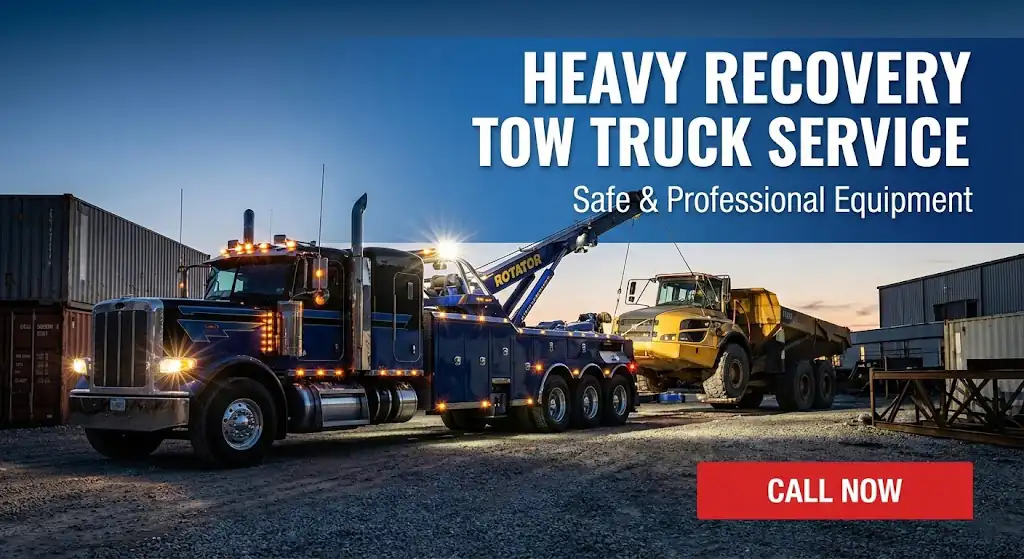
The most advanced and powerful recovery truck available. Rotators feature a 360-degree rotating boom with 35–75 ton lift capacity, allowing operators to reach over guardrails, median barriers, and embankments to recover vehicles that have left the roadway. They are essential for overturned tractor-trailers, bridge and overpass incidents, and confined-space recoveries.
Heavy-Duty Flatbed / Landoll Trailer
For transporting equipment that cannot or should not roll — including tracked machinery, disabled vehicles with seized brakes, and oversized loads. Landoll trailers use a tilt-deck design that lowers to ground level, allowing vehicles and equipment to be driven or winched aboard.
Multi-Axle Carrier
Designed for transporting multiple vehicles or a single heavy piece of equipment across longer distances. Multi-axle carriers distribute weight more evenly and meet Quebec transport weight regulations for highway travel. They are commonly used for long-distance heavy transport across the province.
ScenariosCommon Heavy Duty Towing Situations in Quebec
Quebec’s climate, terrain, and highway system create unique challenges for heavy vehicles. Here are the most common reasons fleet managers, RV owners, and commercial operators call for heavy duty towing:
Truck breakdowns on Autoroute 20, 40, or 73 — Engine failure, blown tires, overheating, or transmission problems on Quebec’s major transport corridors. These require fast response to prevent traffic hazards and secondary collisions.
Tractor-trailer rollovers and jackknifes — Winter ice, high winds, and driver error cause semi-trucks to roll or jackknife. Recovery requires rotator cranes, load transfer planning, and often hazmat protocols for fuel or cargo spillage.
RV and motorhome breakdowns — Class A motorhomes are too large and heavy for standard tow trucks. Tire blowouts, engine failures, and suspension problems on rural Quebec roads require specialized equipment and experienced operators.
Construction equipment transport and recovery — Moving excavators, loaders, and heavy machinery between job sites, or recovering equipment that has slid off a road or into soft ground.
Winter stuck trucks and bus recoveries — Quebec’s snow and ice cause heavy vehicles to slide off roads, get stuck on hills, or lose traction on ramps. Heavy-duty winching recovery is required to pull them free safely.
Accident recovery with debris cleanup — Multi-vehicle collisions involving heavy trucks require towing, load transfer, road cleanup, and coordination with police and insurance towing protocols.
ComparisonHeavy Duty vs Light Duty Towing
Understanding the difference between weight classes helps you request the correct service — and avoid paying for more equipment than you need, or worse, getting a truck that cannot handle the job.
Light Duty
Up to 10K lbs
Sedans, SUVs, pickup trucks, motorcycles. Standard flatbed or wheel lift.
$100–$350
Medium Duty
10K–26K lbs
Box trucks, delivery vans, small RVs, large work trucks.
$300–$600
Heavy Duty
26K–80K+ lbs
Semis, buses, RVs, construction equipment, farm machinery.
$350–$1,500+
For light-duty vehicles like cars and SUVs, see our guides on flatbed towing and breakdown towing. For anything above 10,000 lbs, call us directly for heavy-duty dispatch.
Heavy Duty Dispatch • 24/7
Wreckers, rotators, and heavy carriers — ready for trucks, RVs, and equipment.
PricingHeavy Duty Towing Costs in Quebec (2026)
Heavy duty towing costs significantly more than standard towing due to the specialized equipment, operator training, and time involved. Here are typical price ranges for Quebec in 2026:
*Prices vary by vehicle weight, distance, time of day, weather, terrain, and recovery complexity. For accurate quotes, call (418) 476-1522. See our complete guide to towing costs for general pricing information.
What Drives Heavy Towing Costs Higher?
- Rollover recovery — uprighting a tipped vehicle requires rotator cranes and significantly more time
- Load transfer — cargo from a disabled trailer must be moved to a second truck before towing
- Hazmat protocols — fuel spills, chemical loads, or refrigerant leaks add environmental cleanup requirements
- Off-road or embankment recovery — soft ground, steep grades, and limited access increase complexity
- After-hours and holiday surcharges — night and weekend calls typically add 15–25% to the base rate
- Distance — heavy tows over 50 km add per-kilometre charges on top of the base recovery fee
RV GuideRV and Motorhome Towing in Quebec
Quebec’s scenic routes — from Île d’Orléans to Charlevoix — attract thousands of RV travellers each year. But when a 30-foot motorhome breaks down on a narrow rural road, the recovery requires equipment and expertise that goes far beyond standard towing.
RVs present unique challenges: they are tall (risk of overhead obstructions), wide (narrow Quebec rural roads), heavy (Class A units exceed 25,000 lbs), and often contain propane tanks, water systems, and slide-out mechanisms that must be secured before transport.
Our heavy tow operators secure all slide-outs, disconnect shore power, check propane shutoffs, and verify hitch/tow bar integrity before moving any RV. We have recovered motorhomes from campground mudslides, highway shoulders, and tight residential streets throughout the Quebec City service area.
⚠️ RV Owners: Never allow a standard tow truck to attempt towing your motorhome. The weight exceeds their equipment capacity and can cause brake failure on the tow truck, structural damage to your RV frame, and a dangerous situation for other drivers. Always request a heavy duty tow truck rated for your vehicle’s GVWR.
LocalWhy Quebec Demands Specialized Heavy Towing
Quebec’s geography and climate create conditions that make heavy vehicle recovery more complex than in many other provinces:
Extreme winter conditions: Temperatures regularly hit -25°C to -35°C, causing diesel fuel gelling, air brake freezing, and black ice on highways. Heavy trucks lose traction on steep grades, and recovery operations must be performed in dangerous cold with reduced visibility. Our fleet carries winter-rated equipment and cold-weather hydraulic fluids.
Road surface challenges: Quebec’s freeze-thaw cycle creates severe potholes and uneven road surfaces that can cause tire blowouts and suspension failures on heavy vehicles. During spring thaw, SAAQ-regulated weight restrictions limit truck loads — vehicles that exceed these limits face fines and may need load transfer before towing.
Bridge and overpass height restrictions: Quebec City has numerous overpasses with height restrictions that heavy recovery vehicles must navigate. Our operators know the clearance heights on every route and plan recovery paths that avoid costly delays or equipment strikes.
Traffic and highway complexity: Autoroute interchanges around Quebec City feature tight ramps and merge lanes where a disabled heavy truck creates an immediate safety hazard. Our 24/7 emergency response prioritizes fast lane clearance to minimize traffic disruption and secondary collision risk.
ActionWhat to Do When Your Heavy Vehicle Breaks Down
A heavy vehicle breakdown creates unique safety risks — for you, your cargo, and other motorists. Follow these steps to stay safe and speed up the recovery process:
- Pull as far off the road as possible — Use the shoulder, truck pull-off, or rest area. Avoid blocking travel lanes.
- Activate hazard lights and set triangles/flares — Place warning triangles 50m, 100m, and 150m behind your vehicle as required by Quebec highway safety regulations.
- Set the parking brake and chock wheels — Heavy vehicles on any grade can roll. Use all available braking and chocking.
- Do not attempt roadside repairs on heavy components — Lifting or working under heavy vehicles roadside is extremely dangerous without proper equipment.
- Call a heavy towing specialist immediately — Have your vehicle type, weight (approximate), location, and the nature of the problem ready. Refer to our guide on staying safe while waiting for a tow.
- Notify your fleet manager or dispatcher — If you are a commercial driver, loop in your dispatch for insurance and replacement vehicle coordination.
- Secure cargo — If doors or gates are compromised, ensure cargo is not at risk of spilling onto the roadway.
💡 Fleet Tip: Save Quebec Remorquage’s number — (418) 476-1522 — in every commercial vehicle’s cab. When your driver calls, we dispatch heavy equipment immediately with no membership or pre-registration required. We work directly with insurance providers and fleet managers to streamline billing.
AdviceHow to Choose a Heavy Duty Towing Provider
Not all towing companies can handle heavy recovery. Many advertise “heavy towing” but only own medium-duty equipment. Before you need the service, verify these critical factors:
- Verify equipment capacity — Ask what their heaviest wrecker can handle (in tons). If they cannot answer specifically, they probably lack the equipment.
- Ask about operator training — Heavy recovery requires specialized certification beyond a standard tow truck licence.
- Confirm 24/7 heavy duty availability — Some companies only have heavy trucks available during business hours. A breakdown at 2 AM demands immediate response.
- Check insurance coverage — Heavy recovery insurance must cover loads worth hundreds of thousands of dollars. Ask for proof.
- Review commercial experience — Have they handled semi-truck rollovers, bus recoveries, and equipment transport before? Ask for specifics.
- Confirm upfront pricing — Heavy towing with vague “we’ll see when we get there” pricing is a major red flag.
For a complete checklist on evaluating any towing provider, read our guide to choosing a reliable towing company in Quebec.
ServicesRelated Heavy Vehicle Services
Beyond towing, heavy vehicles often need additional roadside support. Quebec Remorquage provides a full range of services for commercial and oversized vehicles:
- Heavy-duty winching — Off-road and ditch recovery for trucks and equipment using high-capacity winch systems. See winching recovery.
- Battery boost for diesel trucks — Commercial-grade boosters rated for high-amp diesel starts. See battery boost service.
- Tire change for commercial vehicles — On-site spare installation for trucks with accessible spares. See tire change service.
- Long-distance heavy transport — Inter-city and cross-province equipment moves. See long-distance towing.
- Accident recovery and insurance coordination — We work directly with commercial insurance providers for streamlined claims. See accident towing.
- Scrap and end-of-life heavy vehicle removal — Cash for junk trucks, buses, and commercial vehicles. See scrap car removal.
Our full roadside assistance is available for heavy vehicles as well — no membership, no pre-registration, and upfront pricing on every call.
FAQFrequently Asked Questions
What qualifies as heavy duty towing?
Heavy duty towing covers any vehicle or equipment exceeding approximately 10,000 lbs (4,500 kg) — including semi-trucks, buses, RVs, construction machinery, and commercial vehicles. These loads require specialized wreckers, rotators, or heavy flatbed carriers that exceed the capacity of standard tow trucks.
How much does heavy duty towing cost in Quebec?
Costs range from $300 to $500 for a local medium-truck tow, up to $1,500 or more for complex semi-truck recoveries involving rollovers or load transfer. Rotator-based recoveries can exceed $5,000 for severe incidents. Quebec Remorquage provides upfront quotes before dispatching — call (418) 476-1522 for exact pricing.
Can you tow a Class A motorhome or large RV?
Yes. Our heavy-duty wreckers handle Class A, B, and C motorhomes as well as fifth-wheel and travel trailers. Operators secure all slide-outs, propane systems, and hitch assemblies before transport. Standard tow trucks are not rated for motorhome weight and should never be used.
Do you offer heavy duty towing 24/7?
Yes. Our heavy-duty equipment and operators are available 24 hours a day, 7 days a week, including holidays and severe weather. Commercial breakdowns and highway incidents cannot wait until business hours — we dispatch heavy equipment immediately upon your call.
Can you recover an overturned semi-truck?
Yes. Overturned semi-truck recovery requires rotator cranes, load transfer planning, and often coordination with police and environmental services. Our trained operators assess the scene, plan the lift sequence, manage cargo, and upright the vehicle safely. These complex recoveries can take several hours depending on the situation.
Does insurance cover heavy duty towing?
Most commercial auto insurance policies include towing coverage, though limits vary. Fleet policies typically cover heavy recovery after accidents. We work directly with major commercial insurers and can bill them directly in many cases. Always confirm your coverage limits with your provider.
Can you transport construction equipment between job sites?
Yes. We transport excavators, backhoes, skid steers, compactors, and other heavy equipment using Landoll tilt-deck trailers and multi-axle carriers. Equipment is loaded via ramp or winch and secured for highway transport. Call for a quote based on equipment weight, dimensions, and pickup/delivery locations.
What is a rotator tow truck?
A rotator is the most advanced type of heavy-duty tow truck. It features a boom that can rotate 360 degrees, allowing operators to lift and reposition heavy vehicles from virtually any angle — including reaching over guardrails and embankments. Rotators can lift 35 to 75 tons and are essential for the most complex recovery operations.
Do I need to be present during a heavy vehicle recovery?
For commercial vehicles, the driver or a fleet representative should be present to sign authorization and provide cargo information. For personal RVs, the owner should be on-site or reachable by phone to authorize the recovery and confirm the destination. If you cannot be present, we can work with a designated representative or your insurance company.
How long does a heavy duty tow or recovery take?
A straightforward heavy vehicle tow (disabled truck to a nearby shop) can be completed in 45 minutes to 2 hours including dispatch and travel time. Complex recoveries — rollovers, load transfers, off-road extractions — can take 3 to 8 hours or more depending on weight, terrain, weather, and whether cargo must be moved before the vehicle can be lifted. We provide time estimates after assessing the scene.
Heavy Equipment. Heavy Trucks. Handled Right.
Wreckers, rotators, and heavy carriers available 24/7 across Quebec.
Upfront pricing. Insurance coordination. Trained heavy recovery operators.