What Happens After a Car Accident in Quebec? Towing Guide
🚨 Quick Answer
After a car accident in Quebec: 1) Check for injuries and call 911 if needed. 2) Move vehicles off the road if safe. 3) Exchange information. 4) File a joint report (constat amiable) or police report. 5) Call for accident towing to remove your vehicle. 6) Report to the SAAQ and your insurer within 48 hours.
Accident towing cost: $150–$400+ | Insurance covers it? Usually yes | Available: 24/7
The seconds after a car accident are disorienting. Adrenaline floods your system, your hands shake, and your mind races between “Am I okay?” and “What do I do now?” Thousands of Quebec drivers experience this every year — and most do not have a clear plan for what comes next.
The steps you take in the first 30 minutes after a collision determine how smoothly the insurance process goes, whether your vehicle is properly protected, and how quickly you get your life back to normal. Accident towing is a critical part of that process — and choosing the wrong tow operator or skipping key documentation steps can cost you thousands in uncovered repairs.
At Quebec Remorquage, our accident towing service handles the entire vehicle removal process — from scene cleanup to insurance-direct billing. This guide walks you through every step after a car accident in Quebec, from the moment of impact to the final insurance claim.
Step-by-Step: What to Do Immediately After an Accident
Follow these steps in order. They protect your safety, your legal rights, and your insurance claim:
Stop and check for injuries.
Turn off your engine. Check yourself, your passengers, and occupants of the other vehicle. If anyone is injured, call 911 immediately. Do not move injured people unless there is an immediate danger (fire, oncoming traffic).
Secure the scene.
Turn on hazard lights on all involved vehicles. If you can safely move vehicles out of traffic lanes, do so — Quebec law allows this for minor collisions. Place reflective triangles or flares if available. In winter or low visibility, this step is critical to prevent secondary collisions.
Call 911 if required.
In Quebec, you must call police if there are injuries, if damage appears to exceed $2,000, if a vehicle must be towed from the scene, or if a driver appears impaired. For minor fender-benders with no injuries, a police report is not always required — but filing one protects you during insurance disputes.
Exchange information with the other driver.
Collect: full name, driver’s licence number, licence plate number, insurance company and policy number, phone number, and vehicle make/model/colour. Do not discuss fault at the scene — simply exchange information calmly and factually.
Document everything with photos.
Photograph all vehicles from multiple angles, close-ups of damage, the accident scene layout, skid marks, traffic signs, road conditions, and weather. Take photos of the other driver’s licence, registration, and insurance card. These photos become essential evidence during insurance claims.
Fill out the joint report (constat amiable).
If police do not attend, Quebec uses a joint accident report form called a constat amiable. Both drivers fill it out together at the scene. It documents the circumstances, positions of vehicles, and each driver’s account. Keep a copy in your glove box — you can get blank forms from your insurer or the SAAQ.
Call for accident towing.
If your vehicle is not driveable, call (418) 476-1522 for accident towing. Tell the dispatcher it is an accident, whether police are on scene, and where you want the vehicle taken (body shop, home, or insurance-approved facility). We handle debris cleanup and can bill your insurer directly in most cases.
💡 Critical Tip: Do not admit fault at the scene — even if you think the accident was your fault. Fault determination in Quebec follows specific SAAQ and insurance rules that consider factors you may not be aware of. Simply describe what happened factually without assigning blame.
How Accident Towing Works in Quebec
Accident towing is different from a standard breakdown tow. The vehicle may have structural damage, fluid leaks, broken glass, or deployed airbags — all of which require special handling:
- Scene assessment — The operator evaluates whether the vehicle can be safely loaded, checks for fluid leaks (fuel, coolant, oil), and identifies structural damage that affects loading
- Debris cleanup — Broken glass, bumper pieces, and vehicle fragments are cleared from the roadway to prevent hazards for other drivers
- Safe loading — Accident-damaged vehicles are almost always loaded onto a flatbed truck because bent frames, damaged suspension, or flat tires make wheel-lift towing unsafe
- Destination coordination — You choose where the vehicle goes: your preferred body shop, home, dealership, or an insurance-approved assessment centre
- Insurance documentation — We provide detailed towing receipts with scene photos, pickup/drop-off locations, and timestamps that your insurer requires for claim processing
Quebec Remorquage handles all of this in a single service call. Our operators are experienced with accident scenes and work alongside police, paramedics, and other emergency responders when they are present.
Accident Towing Costs in Quebec (2026)
Accident towing costs more than a standard breakdown tow because of the additional scene work, flatbed requirement, and cleanup involved:
*Prices vary by distance, vehicle weight, and recovery complexity. Call (418) 476-1522 for exact quotes. For all service pricing, see our complete towing cost guide.
The good news: accident towing is almost always covered by auto insurance in Quebec when the tow is directly related to a collision. Your insurer reimburses the tow as part of the claim — either through direct billing (we bill them) or reimbursement (you pay and submit the receipt). Quebec Remorquage works with all major insurers and can arrange direct billing in most cases.
Quebec Insurance and Towing After an Accident
Quebec’s auto insurance system is unique in Canada. The SAAQ (Société de l’assurance automobile du Québec) handles bodily injury compensation through a public no-fault system. Property damage — including vehicle repair and towing — is handled by your private insurer.
Here is how insurance and towing interact after an accident:
- Towing is covered under collision or comprehensive coverage. If you carry collision insurance (mandatory in Quebec for financed vehicles, optional otherwise), the tow after an accident is a covered expense within your policy limits.
- You choose the tow company. Your insurer may suggest a preferred provider, but in Quebec, you have the right to choose your own tow company. You are not required to use whoever the insurer recommends.
- You choose the body shop. Similarly, you can direct your vehicle to any body shop you prefer — you are not obligated to use an insurer-recommended facility.
- Keep all receipts. The towing receipt, storage fees, and any related costs should be documented and submitted with your claim.
- Report the accident within 48 hours. Quebec requires reporting accidents to both the SAAQ (if injuries occurred) and your private insurer promptly. Delayed reporting can complicate claims.
💡 Direct Billing Advantage: When you use Quebec Remorquage for accident towing, we can bill your insurer directly in most cases. This means you pay nothing out of pocket for the tow — it goes straight to your insurance claim. Ask the dispatcher about direct billing when you call. See our insurance towing page for details.
Accident? We Handle the Tow and the Paperwork.
24/7 accident towing • Direct insurance billing • Scene cleanup included
Common Mistakes Drivers Make After an Accident
Stress leads to errors. Avoid these common post-accident mistakes that can cost you money and complicate your claim:
- Leaving the scene without exchanging information — This is a criminal offence in Quebec, even in minor collisions. Always stop, check for injuries, and exchange details.
- Admitting fault at the scene — Saying “I am sorry” or “It was my fault” can be used against you. Stick to factual descriptions of what happened.
- Not taking photos — Your memory of the scene will fade. Photos are the most powerful evidence in insurance disputes. Take too many rather than too few.
- Letting the other driver talk you out of filing a report — “Let us handle this privately” often means the other driver intends to dispute the claim later. Always file a report, even for small damage.
- Using any tow company that shows up uninvited — Some tow operators patrol accident-prone areas and arrive before being called, then charge inflated rates. Only use a company you called yourself.
- Driving a damaged vehicle home — A car that “seems fine” may have hidden structural damage, leaking fluids, or compromised safety systems. If in doubt, have it towed and inspected.
- Waiting too long to report — Insurance and SAAQ reporting deadlines are strict. Report within 48 hours to protect your claim.
⚠️ Watch for Predatory Towing. Uninvited tow trucks that arrive at accident scenes without being called are a known issue in Quebec. They may charge double or triple standard rates, tow your vehicle to a lot you did not choose, and hold it until you pay excessive storage fees. Always call your own towing company. Learn how to vet operators in our guide to choosing a reliable towing company.
Should You Drive Your Car After an Accident or Have It Towed?
After a collision, resist the urge to “just drive it home.” Check these items first:
- Fluid leaks — Look under the car for coolant (green/orange), oil (dark brown/black), or transmission fluid (red/pink). Any leak means the car should be towed.
- Tire damage — Flat, bulging, or visibly damaged tires make driving dangerous. Call for a tire change or tow.
- Steering alignment — If the steering wheel is off-centre or pulls to one side, suspension or steering components are likely bent. Do not drive.
- Airbag deployment — If any airbags deployed, the vehicle must be towed. Deployed airbags indicate significant impact force and possible structural damage.
- Warning lights — Check engine, ABS, airbag, or stability control lights on the dashboard indicate compromised systems. Have the car inspected before driving.
- Body damage blocking vision — A crumpled hood, broken headlights, or a shattered windshield make the vehicle unsafe and potentially illegal to drive.
When in doubt, tow it. The cost of a $200 tow is nothing compared to a second accident caused by hidden damage — or a denied insurance claim because you drove on a vehicle your insurer considers should have been towed. For AWD or 4WD vehicles, always request flatbed towing to protect the drivetrain.
Vehicle Storage After an Accident: What to Know
If your vehicle cannot go directly to a body shop (it is late at night, the shop is closed, or you need time to choose a repair facility), it may need temporary storage. Here is what to keep in mind:
- Storage fees are typically $25–$60 per day — these fees accumulate quickly, so move your vehicle to a body shop or home as soon as possible
- Insurance usually covers reasonable storage — most policies cover storage for a limited period while you arrange repairs, but not indefinitely
- Remove personal belongings promptly — storage lots are not responsible for items left in your vehicle
- Ask about storage before agreeing to a tow — know where the vehicle will be stored, how much it costs per day, and what hours you can access it
Quebec Remorquage can tow directly to your chosen body shop, your home, or a secure temporary storage facility. We always discuss the destination and any storage implications before dispatch — no surprises.
Winter Accidents in Quebec: Additional Considerations
Winter accidents in Quebec carry extra complications that make proper accident towing even more important:
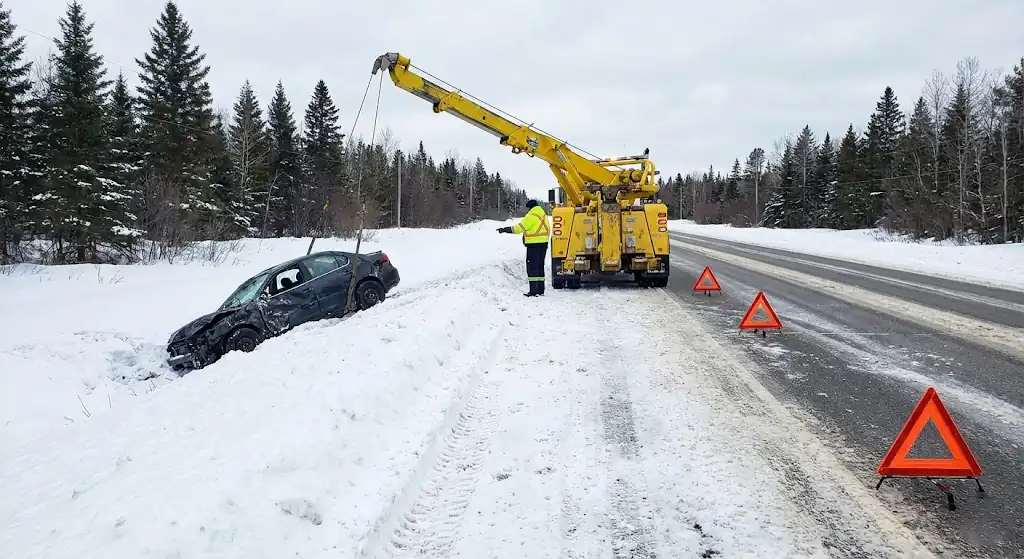
- Vehicles often slide off the road after impact — requiring winching recovery before the flatbed can load
- Road conditions make scene safety critical — ice and reduced visibility increase the risk of secondary collisions while you wait for a tow
- Cold temperatures limit how long you can wait safely — if your vehicle is not running, exposure at -20°C becomes a medical concern within 30 minutes
- Snow can hide damage — undercarriage impact with snowbanks or hidden curbs may cause damage not visible until the snow melts
- Salt and brine accelerate exposed metal corrosion — accident-exposed body panels rust rapidly when coated in road salt. Getting the vehicle to a body shop quickly limits secondary damage
For comprehensive winter safety preparation, read our winter breakdown safety guide and keep a winter survival kit in your vehicle at all times.
Related Services After an Accident
An accident often requires more than just towing. Quebec Remorquage’s full service lineup covers everything you may need:
- Vehicle in a ditch after the collision? Winching recovery extracts it before flatbed loading
- AWD or electric vehicle? Flatbed towing protects the drivetrain
- Heavy truck accident? Heavy-duty towing handles commercial vehicles
- Need the vehicle moved far? Long-distance towing to out-of-town body shops
- Dead battery from sitting? Battery boost after the car is repaired
- Keys locked in the damaged car? Car unlocking without further damage
- Car is a total loss? Scrap car removal with cash payment
All services available 24/7 across the Quebec City service area — Sainte-Foy, Beauport, Charlesbourg, Limoilou. For more on what to do while waiting for help, see our stranded driver safety guide.
Frequently Asked Questions
Does insurance cover accident towing in Quebec?
Yes, in most cases. If you carry collision or comprehensive coverage, towing after an accident is typically covered as part of your claim. Coverage limits vary by policy — some cover $100, others cover the full towing cost. Quebec Remorquage can bill your insurer directly so you pay nothing out of pocket for the tow.
Can I choose my own towing company after an accident?
Yes. In Quebec, you have the right to choose your own towing provider regardless of what your insurer recommends. Your insurer cannot require you to use a specific tow company. Call a provider you trust and keep the receipt for reimbursement or direct billing.
How much does accident towing cost in Quebec?
Accident towing in the Quebec City area typically costs $150 to $400 depending on vehicle size, distance, and recovery complexity. Severe accidents involving ditch extraction or rollovers can exceed $600. After-hours surcharges of $25 to $75 may apply. Most of these costs are covered by insurance.
When do I need to call the police after a car accident?
In Quebec, call police if anyone is injured, if damage appears to exceed $2,000, if a vehicle needs to be towed from the scene, if a driver appears impaired, or if you suspect the other driver does not have valid insurance. For minor fender-benders with no injuries, a joint report (constat amiable) between drivers is sufficient.
What is a constat amiable?
A constat amiable is a joint accident report form used in Quebec when police do not attend the scene. Both drivers fill it out together, documenting the circumstances, vehicle positions, and each person’s account. It is used by insurers to determine fault and process claims. Keep blank forms in your glove box — available from your insurer or the SAAQ website.
Should I move my car after an accident?
If the accident is minor and the vehicles are blocking traffic, Quebec law allows and encourages you to move them to the shoulder or a safe area. Take photos of the original positions first. If the collision is severe, vehicles should remain in place until police arrive, unless they pose an immediate safety hazard.
What if a tow truck shows up at the accident without being called?
This is known as “ambulance chasing” in the towing industry. Uninvited tow trucks often charge inflated rates and may tow your vehicle to a lot you did not choose. You are under no obligation to use an uninvited tow operator. Politely decline and call your own trusted provider instead.
How soon should I report an accident to my insurance?
Report to your insurer as soon as possible — ideally within 24 to 48 hours. Most Quebec insurance policies require prompt reporting, and delays can complicate or weaken your claim. If there were injuries, also report to the SAAQ within the required timeframe for bodily injury compensation.
Can you tow my car directly to a body shop at night?
Yes. Many body shops accept after-hours vehicle drop-offs in secure lots. We coordinate with the shop and place your vehicle in their designated area. If the body shop does not accept overnight deliveries, we can store your vehicle temporarily and deliver it the next business day. Ask our dispatcher about your preferred body shop’s drop-off policy.
What if my car is a total loss after the accident?
If your insurer declares the vehicle a total loss, they will pay you the pre-accident market value minus your deductible. The vehicle then belongs to the insurer. If you want to keep the vehicle (for parts or rebuilding), your insurer may allow it at a reduced payout. For vehicles beyond repair with no insurance, our scrap car removal service pays cash for the vehicle regardless of condition.
In an Accident? One Call Handles Everything.
Towing, scene cleanup, insurance billing, body shop delivery — all in one call.
24/7 accident towing across Quebec City. Direct insurance billing available.