How to Tow an AWD or 4WD Vehicle Safely in Quebec
❄️ Quick Answer
AWD and 4WD vehicles must be towed on a flatbed — period. Dragging any wheels on the ground while the drivetrain is engaged forces unpowered components to spin, generating friction and heat that destroys the transfer case, centre differential, and transmission. Flatbed towing eliminates this risk entirely by lifting all four wheels off the ground.
Flatbed tow cost: $95–$150 base + $4–$6/km | Repair cost if towed wrong: $3,000–$8,000+
Your Subaru Outback breaks down on Boulevard Laurier. Or your Toyota RAV4 gets rear-ended in a Charlesbourg parking lot. Or your Ford F-150 with 4WD will not start after a long weekend at the cottage. You call for a tow — and the truck that shows up is a wheel lift, not a flatbed. If you let that operator hook up your vehicle and drag it with two wheels on the pavement, you are looking at a repair bill that dwarfs the cost of the tow itself.
Flatbed towing is not optional for AWD and 4WD vehicles — it is mandatory to prevent drivetrain destruction. Yet every winter in Quebec, vehicles are incorrectly towed by operators who either do not know or do not care about drivetrain requirements. The damage is invisible until you try to drive — and then you are facing a $3,000 to $8,000 repair.
At Quebec Remorquage, every flatbed towing call for an AWD or 4WD vehicle is handled with the right equipment from the start — no shortcuts, no wheel lifts, no risk to your drivetrain. This guide explains exactly why flatbed towing is required, what happens when it is done wrong, which Quebec vehicles need it, and what it costs.
Why AWD and 4WD Vehicles Require Flatbed Towing
To understand why flatbed towing is the only safe method, you need to understand how AWD and 4WD drivetrains work — and why dragging wheels creates catastrophic problems.
In a standard front-wheel-drive car, only the front axle is connected to the transmission. A wheel lift can safely raise the front wheels off the ground and tow the car with the rear wheels rolling freely — because the rear wheels have no mechanical connection to the drivetrain.
In AWD and 4WD vehicles, all four wheels are mechanically connected through a transfer case and/or centre differential. When you drag any wheels on the ground, those wheels spin. That spinning feeds rotational energy backward through the drivetrain — into the differential, through the driveshaft, and into the transfer case and transmission. Without engine lubrication pumping through the system, the friction generates extreme heat that destroys internal components within minutes.
Flatbed towing solves this completely by placing all four wheels on the truck bed. No wheels on the ground. No spinning. No drivetrain engagement. Zero damage.
What Happens When an AWD Vehicle Is Towed Wrong
The damage from incorrect towing is severe, expensive, and often not immediately visible. Here is what can fail:
Transfer Case Failure
Internal gears and bearings overheat from unlubricated spinning. Metal shavings contaminate the fluid, accelerating destruction.
Repair: $1,500–$3,500
Centre Differential Damage
The centre differential allows front and rear axles to rotate at different speeds. Forced spinning without lubrication welds internal clutch packs or gears together.
Repair: $1,200–$2,500
Transmission Damage
Rotational energy from dragged wheels feeds into the transmission output shaft. Without the engine running, no fluid pressure means no lubrication — internal clutches and planetary gears burn.
Repair: $2,500–$5,000+
Driveshaft & CV Joint Wear
Driveshafts and CV joints spinning at highway speed without proper support create vibrations, heat, and premature wear that leads to failure weeks or months later.
Repair: $500–$1,500
⚠️ The damage is often silent. You may not hear grinding or see warning lights immediately after an incorrect tow. The internal damage accumulates — and surfaces weeks later as transmission slipping, grinding noises, or a complete drivetrain failure. By then, the towing company is long gone and proving the connection is difficult. The only safe approach is to prevent it entirely by insisting on flatbed towing.
AWD vs 4WD: Both Need Flatbed, But for Different Reasons
Drivers often confuse AWD and 4WD. Both require flatbed towing, but they work differently:
🔄 All-Wheel Drive (AWD)
- Power goes to all wheels continuously
- No driver-selectable modes
- Cannot be disconnected for towing
- Common: Subaru, Audi, most crossovers
- Flatbed is the only option
⚠️ Zero exceptions — always flatbed
⚙️ Four-Wheel Drive (4WD)
- Driver selects 2WD or 4WD mode
- Has a transfer case with selectable ranges
- Some models allow 2WD neutral for towing
- Common: Jeep Wrangler, Toyota 4Runner, trucks
- Flatbed is strongly recommended
⚠️ Flatbed safest even if 2WD is available
The safe rule: If your vehicle has AWD or 4WD badging anywhere — on the tailgate, in the owner’s manual, or on the window sticker — request flatbed towing. Do not attempt to determine whether your specific transfer case can be set to neutral for towing. The risk of getting it wrong far outweighs the marginal cost difference between a wheel lift and a flatbed.
Quebec Vehicles That Require Flatbed Towing
AWD and 4WD are extremely popular in Quebec because of winter driving conditions. According to the SAAQ, the majority of new vehicles registered in Quebec now feature some form of all-wheel drive. Here are the most common models we tow on flatbeds:
Not sure if your vehicle is AWD? Check the badging on the rear (AWD, 4WD, 4×4, Quattro, xDrive, 4MATIC, Symmetrical AWD). Check the owner’s manual. Or simply tell our dispatcher the year, make, and model — we will determine the correct towing method before the truck leaves.
Flatbed Towing Costs for AWD Vehicles in Quebec (2026)
Flatbed towing costs slightly more than a wheel lift because the equipment is larger and more expensive to operate. But the cost difference is trivial compared to drivetrain repair bills:
*Prices vary by distance, time of day, and vehicle weight. For exact quotes, call (418) 476-1522. See our complete towing cost guide for all pricing details.
The math is clear: the $20–$70 premium for flatbed towing over a wheel lift is the cheapest insurance you will ever buy against a $3,000–$8,000 drivetrain repair. Any towing company that tries to convince you a wheel lift is “fine” for your AWD is either uninformed or prioritizing their convenience over your vehicle’s safety.
Flatbed Towing • AWD & 4WD Safe • 24/7
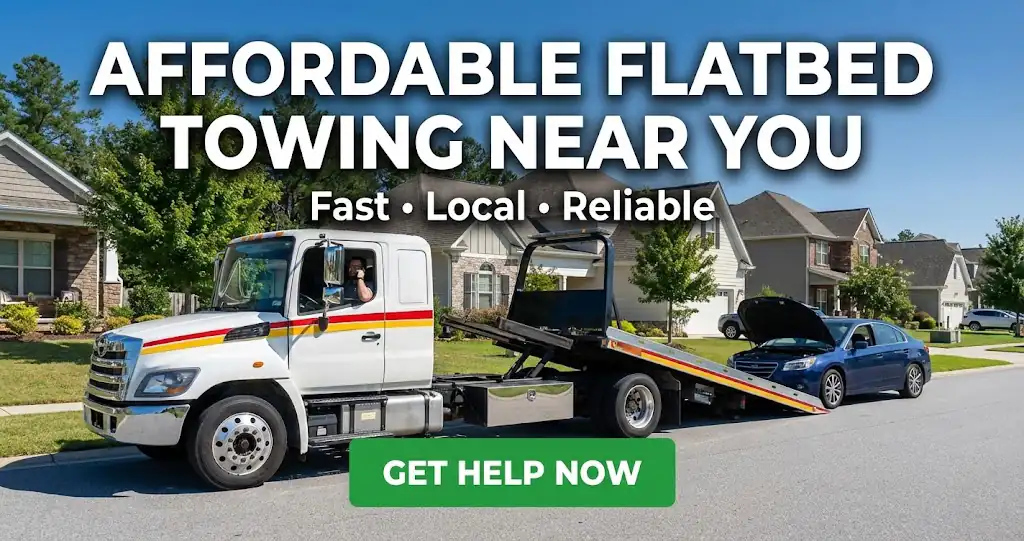
All four wheels off the ground — every time. Subaru, Toyota, Honda, Jeep, Tesla, Audi, BMW and more.
Quebec Winter and AWD: More Vehicles, More Towing Risk
Quebec’s harsh winters have made AWD and 4WD the default choice for new vehicle buyers. Subaru Outbacks, Toyota RAV4s, Honda CR-Vs, and AWD crossovers dominate the province’s roads precisely because they handle snow and ice better than two-wheel-drive alternatives.
But this popularity creates a towing problem: during winter storm events and heavy snowfall, demand for towing spikes — and not every truck dispatched is a flatbed. Under pressure to respond quickly, some operators send wheel lifts to AWD vehicles because it is the truck they have available. The driver, cold and stressed, agrees — and the damage begins.
Your protection: When you call for a tow, explicitly state your vehicle is AWD or 4WD and that you require a flatbed. If the company cannot guarantee a flatbed, call another company. Quebec Remorquage maintains dedicated flatbed trucks specifically for AWD and 4WD calls — even during storm surges. For more winter-specific guidance, see our winter breakdown safety guide and our guide to staying safe while stranded.
What to Tell the Tow Truck Dispatcher
When you call for a tow on an AWD or 4WD vehicle, make these points clearly:
- “My vehicle is AWD” or “My vehicle is 4WD” — state this immediately
- Year, make, and model — “2023 Subaru Outback” tells the dispatcher everything they need
- “I need a flatbed” — do not leave it to the dispatcher to decide. Request it explicitly
- “Can you confirm a flatbed is being sent?” — get verbal confirmation before hanging up
- Your exact location — address, highway marker, parking lot name, or GPS pin
- The vehicle’s current state — is it driveable, stuck, in a ditch, or in an accident scene?
💡 When the Truck Arrives: Before the operator touches your vehicle, confirm it is a flatbed and that all four wheels will be loaded off the ground. If a wheel lift shows up instead, refuse the service and call another provider. The $200 tow is not worth the $5,000 repair. Read our guide to choosing a reliable towing company for more evaluation tips.
Electric Vehicles: Every EV Needs Flatbed Towing Too
Electric vehicles present an even stronger case for flatbed towing than traditional AWD vehicles. Here is why:
- Electric motors generate electricity when wheels spin. Dragging an EV’s drive wheels creates regenerative braking energy with nowhere to go, which can overheat and damage the motor and battery management system.
- Dual-motor EVs are effectively AWD. Tesla Model Y Long Range, Model 3 Long Range, and Model X all have front and rear motors — making every wheel mechanically connected.
- Even single-motor EVs should be flatbedded. Manufacturers like Tesla, Hyundai, and Kia explicitly state in their owner’s manuals that wheel-dragging is prohibited.
- Heavy battery packs stress wheel-lift equipment. EVs are 300–700 kg heavier than comparable gas vehicles, exceeding the safe capacity of some wheel lift trucks.
As EV adoption grows in Quebec, flatbed towing demand will only increase. Our fleet is equipped for all current EV models — Tesla, Hyundai Ioniq 5/6, Kia EV6, Chevrolet Bolt, Ford Mustang Mach-E, and more. For motorcycle transport needs, see our motorcycle towing service.
Complete Service for Every Vehicle Situation
AWD breakdowns come in many forms. Quebec Remorquage’s full service lineup covers them all:
- AWD stuck in snow? Winching recovery first, then flatbed if needed
- Dead battery on your Subaru? Battery boost — no tow required
- Flat tire on your CR-V? Tire change service installs your spare
- AWD accident? Accident towing with insurance coordination
- Long-distance AWD transport? Long-distance flatbed towing
- Keys locked inside? Car unlocking — no tow needed
- Heavy AWD truck (F-250, Ram 2500)? Heavy-duty towing
Available 24/7 across the Quebec City service area — Sainte-Foy, Beauport, Charlesbourg, Limoilou.
Frequently Asked Questions
Can you tow an AWD vehicle with a wheel lift?
No. Towing an AWD vehicle with any wheels on the ground will damage the transfer case, centre differential, and transmission. All four wheels must be off the ground, which means flatbed towing is the only safe method. This applies to all AWD systems regardless of brand.
How much more does flatbed towing cost than a wheel lift?
Flatbed towing typically costs $20 to $70 more than a wheel lift for the same distance. On a 15 km tow, the difference might be $40 to $70. Compare that to $3,000 to $8,000 for drivetrain repair from incorrect towing — the flatbed premium is negligible.
Does my Subaru need flatbed towing?
Yes — every Subaru model (Outback, Forester, Crosstrek, Impreza, WRX, Legacy, Ascent) uses Symmetrical AWD as standard equipment. All Subarus must be flatbed towed. Subaru explicitly states this in their owner’s manuals and dealer service guidelines.
Can a 4WD truck be towed in 2WD mode?
Some 4WD trucks with a selectable transfer case can theoretically be towed in 2WD mode with the rear wheels lifted. However, this depends on the specific transfer case design and whether neutral can be properly engaged with the engine off. The safest approach is always a flatbed — incorrect transfer case settings during a stressful breakdown can easily lead to costly mistakes.
Do electric vehicles need flatbed towing?
Yes. All electric vehicles — whether single-motor or dual-motor — require flatbed towing. Dragging drive wheels creates regenerative energy that can damage the electric motor and battery system. Tesla, Hyundai, Kia, and all other EV manufacturers specify flatbed-only towing in their owner’s manuals.
What if a wheel lift already towed my AWD vehicle?
Have the vehicle inspected by a transmission specialist as soon as possible. Check the transfer case fluid for discolouration or a burnt smell, and inspect for any unusual noises or vibrations during driving. Damage may not be immediately apparent but can worsen over time. Document the incorrect tow (photos, receipts) in case you need to file a claim against the towing company.
Is flatbed towing available 24/7 in Quebec?
Yes. Quebec Remorquage provides flatbed towing 24 hours a day, 7 days a week, including holidays and during winter storms. We maintain dedicated flatbed trucks for AWD and 4WD vehicles and do not substitute wheel lifts when flatbed demand is high.
Does insurance cover flatbed towing for AWD vehicles?
Most auto insurance policies that include towing coverage do not distinguish between flatbed and wheel lift — they cover “towing” up to a dollar amount per incident. The flatbed premium usually falls within standard coverage limits. After an accident, towing is typically covered under collision coverage. Check your policy or ask our dispatcher about direct insurance billing.
How do I know if my car is AWD or FWD?
Check for AWD, 4WD, 4×4, Quattro, xDrive, 4MATIC, or i-ACTIV badges on the rear of the vehicle. Check the window sticker, vehicle registration, or owner’s manual. You can also tell our dispatcher the year, make, and model — we know which configurations require flatbed towing and will send the correct truck.
Can you use tow dollies for AWD vehicles?
Tow dollies lift only two wheels. For AWD vehicles, the remaining two wheels on the ground still spin the drivetrain — causing the same damage as a wheel lift. The only safe option is a flatbed where all four wheels are completely off the ground. Dollies are acceptable only for FWD vehicles where the rear wheels have no drivetrain connection.
Your AWD Deserves Four Wheels Off the Ground.
24/7 flatbed towing for every AWD, 4WD, and EV in Quebec.
Subaru. Toyota. Honda. Jeep. Tesla. Audi. BMW. All models. No shortcuts.