Electric Vehicle Towing: What Quebec EV Drivers Must Know
⚡ Quick Answer
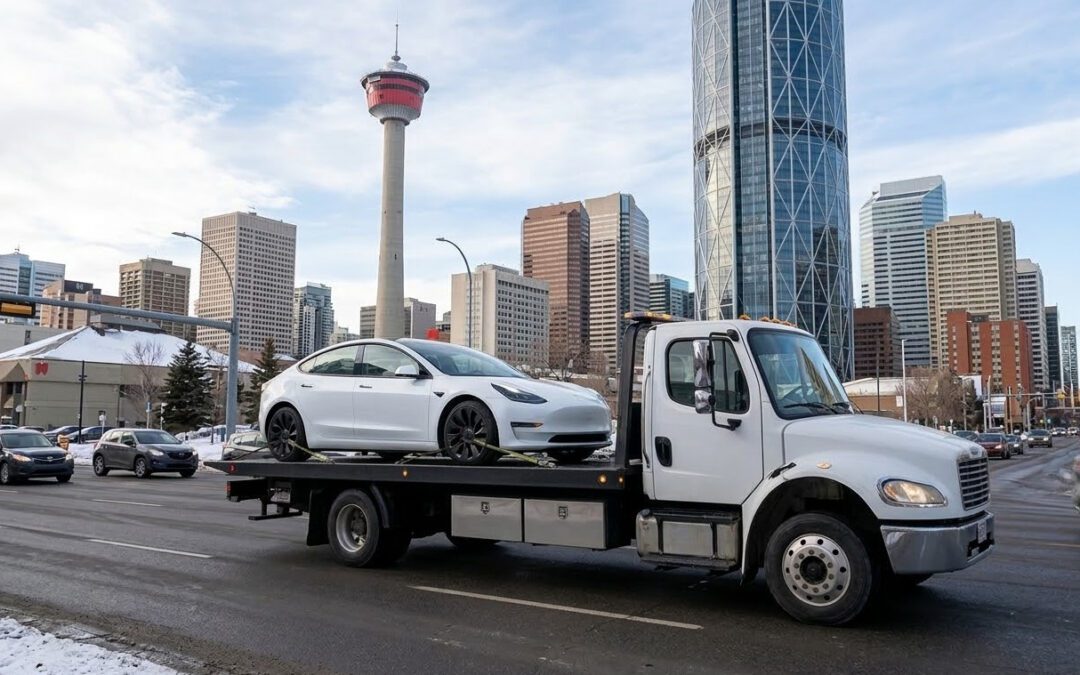
Every electric vehicle must be towed on a flatbed — no exceptions. Dragging any drive wheels on the ground forces the electric motor to spin as a generator, creating energy with nowhere to go. This damages the motor, overheats the battery management system, and can trigger thermal events. Electric vehicle towing on a flatbed eliminates all of these risks.
Flatbed EV tow: $125–$300+ | Damage from wrong tow: $5,000–$15,000+
Quebec is one of Canada’s fastest-growing markets for electric vehicles. Teslas, Hyundai Ioniq 5s, Kia EV6s, Chevrolet Bolts, and Ford Mustang Mach-Es are now a common sight on Autoroute 40, Boulevard Laurier, and every Charlesbourg side street. But when one of these vehicles breaks down, runs out of charge, or gets into an accident, most tow truck operators reach for the same equipment they use on gas-powered cars — and that is where thousands of dollars in damage begins.
Electric vehicle towing is fundamentally different from towing a gas car. The drivetrain architecture, the battery pack location, the weight distribution, and the regenerative systems all demand specific equipment and handling. A tow operator who does not understand EV-specific requirements can cause damage that dwarfs the cost of the tow itself.
At Quebec Remorquage, our flatbed towing service is equipped for every EV currently on Quebec roads. This guide explains why electric vehicle towing requires a flatbed, what risks exist, which EVs need special attention, and what it costs.
EssentialWhy Every EV Must Be Flatbed Towed
Electric vehicles cannot be towed with any wheels on the ground. This is not a recommendation — it is a manufacturer requirement for every major EV brand. Here is why:
- Electric motors act as generators when wheels spin. In a gas car, the drivetrain disengages when the engine is off. In an EV, the motor is permanently connected to the wheels. Dragging the wheels forces the motor to generate electricity — with no system managing that energy, it creates heat, voltage spikes, and potential damage to the motor windings and power electronics.
- Regenerative braking cannot be disabled during towing. Most EVs use regenerative braking that activates whenever the wheels turn. During a wheel-drag tow, this system fights the tow, creates resistance, and pushes energy back into the battery in an uncontrolled way.
- Battery management systems are not designed for external charging. Energy generated by dragged wheels bypasses the battery management system (BMS), which normally controls voltage, temperature, and charge rate. Unmanaged energy input can overheat individual battery cells — a thermal runaway precursor.
- Heavy battery packs stress wheel-lift equipment. EV battery packs add 300–700 kg to the curb weight. A Tesla Model Y weighs over 2,000 kg — heavier than many mid-size SUVs. This weight can exceed the safe capacity of lighter wheel-lift trucks.
⚠️ Manufacturer Warnings Are Explicit. Tesla’s owner’s manual states: “Never transport Model 3 with the tires in a position where they can spin.” Hyundai, Kia, BMW, Mercedes, Volkswagen, and Ford all include identical warnings for their EVs. Violating these instructions voids warranty coverage for any resulting damage and creates liability for the tow operator.
ReferenceElectric Vehicles on Quebec Roads That Need Flatbed Towing
Here are the most common EVs in Quebec and their towing specifications:
Notice the pattern: every single EV requires flatbed towing — regardless of whether it is RWD, FWD, or AWD. Even single-motor, front-wheel-drive EVs like the base Chevrolet Bolt cannot have their drive wheels dragged. The motor-to-wheel connection in an EV is permanent and cannot be disengaged for towing. According to the SAAQ, Quebec’s EV registrations have grown significantly in recent years, making EV-safe towing an essential service.
PricingElectric Vehicle Towing Costs in Quebec (2026)
Electric vehicle towing costs slightly more than standard gas-car towing because of the flatbed requirement and the extra weight involved. Here are typical Quebec City rates:
*Call (418) 476-1522 for exact quotes. Full pricing at our towing cost guide.
The math is stark. The flatbed premium for an EV tow versus a standard gas-car tow is typically $20–$75. The repair bill for motor or battery damage from incorrect towing starts at $5,000 and can exceed $15,000 — approaching the cost of a new battery pack. The flatbed is not an upgrade; it is mandatory insurance.
WarningWhat Happens When an EV Is Towed Incorrectly
Dragging an EV’s drive wheels — even for a short distance — can trigger a chain of failures:
Motor Damage
The electric motor spins as a generator, creating voltage with no load management. Windings overheat and insulation breaks down, leading to short circuits or complete motor failure.
Repair: $3,000–$8,000
Inverter Failure
Uncontrolled voltage spikes from forced motor generation can destroy the power inverter — the component that converts DC battery power to AC motor power. Replacement requires factory parts.
Repair: $2,000–$5,000
Battery Thermal Event Risk
Unmanaged energy forced into battery cells bypasses thermal protection. Individual cells can overheat, swell, or vent — the precursor to thermal runaway, which in worst cases leads to battery fire.
Battery pack: $8,000–$15,000+
And the damage may not show immediately. Unlike a gas car’s transmission that grinds audibly when damaged, EV motor and inverter damage can be silent until a fault code triggers days or weeks later. By then, proving the tow caused the damage is extremely difficult. Prevention through proper electric vehicle towing is the only reliable protection.
CommonRan Out of Charge? Here Is What to Do
Running out of battery charge is the EV equivalent of running out of gas — and it is the most common reason for EV roadside calls in Quebec. Unlike a gas car, you cannot get a jerry can of electrons delivered to you. Here is what to do:
- Pull over safely and turn on hazard lights. Most EVs give ample warning before full shutdown — use the remaining range to find a safe stopping point.
- Do not attempt to push the vehicle to a charger. EVs are extremely heavy (1,500–2,500 kg) and cannot be pushed safely on any kind of slope or road.
- Call for a flatbed tow to the nearest Level 2 or DC fast charging station, your home charger, or an EV-certified dealer. Tell the dispatcher you have an EV with zero charge — we send a flatbed equipped for the extra weight.
- Check for nearby chargers on your phone. Apps like PlugShare, ChargeHub, and your vehicle’s built-in map show the closest charging stations. Pick the closest one as your tow destination to minimize cost.
💡 Tesla Owners: Tesla Roadside Assistance can dispatch a flatbed through their app or by calling their support line. However, response times vary and they may contract a third party. If you want faster response, call Quebec Remorquage directly at (418) 476-1522 — we are local and typically arrive in 15–30 minutes.
EV Flatbed Towing • All Models • 24/7
Tesla, Hyundai, Kia, Chevrolet, Ford, BMW, VW, Nissan — every EV, every situation.
QuebecEVs in Quebec Winter: Range Loss and Towing Risks
Quebec winters are the harshest test an EV battery can face — and the primary reason EV towing calls spike from November through March:
- Range drops 30–50% in extreme cold. At -25°C, a battery rated for 400 km may deliver only 200–280 km. Cabin heating, defrosting, and heated seats all draw directly from the battery, reducing driving range further.
- Charging is slower in cold weather. DC fast charging at low battery temperatures is significantly slower because the battery must warm itself before accepting high charge rates. What takes 30 minutes in summer may take 60+ minutes in January.
- More “out of charge” stranding. Drivers who rely on summer range estimates in winter get caught short. Quebec’s rural highways between towns may have 50+ km gaps between charging stations — and a 50% range reduction turns that gap into a gamble.
- Road conditions increase towing difficulty. Icy roads, snow-covered shoulders, and limited-visibility conditions make EV recoveries more complex and time-consuming.
For winter preparation specific to Quebec driving, read our winter breakdown safety guide and winter survival kit essentials.
ProcessHow We Load and Transport EVs Safely
Quebec Remorquage follows manufacturer-specific protocols for every EV tow:
- Transport mode activation — Many EVs have a “Transport Mode” or “Tow Mode” in settings that disables the parking brake and allows the wheels to roll freely during loading. Our operators know how to activate this for each brand.
- Flatbed angle adjustment — EVs sit lower than many gas vehicles due to the underfloor battery pack. The flatbed ramp angle is minimized to prevent scraping the battery casing on the approach.
- Tie-down point identification — EV manufacturers specify exact tie-down locations that avoid battery pack contact zones. Using incorrect points risks damaging the battery housing or high-voltage components.
- No-contact zones respected — The underside of an EV contains high-voltage cabling and the battery pack. Our operators never place chains, hooks, or straps in contact with the undercarriage outside designated points.
- Weight capacity verified — EVs are 300–700 kg heavier than comparable gas cars. Our flatbed trucks are rated for EV weights with adequate capacity margin.
These are not optional extras — they are standard procedure for every electric vehicle towing call we handle. If a tow operator arrives without knowing how to activate your EV’s transport mode, they are not equipped for the job.
ChecklistWhat to Tell the Dispatcher When Calling for an EV Tow
Help us send the right truck and equipment by providing these details:
- “My vehicle is electric” — state this first so a flatbed is dispatched immediately
- Year, make, and model — “2024 Tesla Model Y” tells us the weight class and tie-down requirements
- What happened — ran out of charge, mechanical issue, accident, flat tire, or other problem
- Current charge level (if the screen is accessible) — helps us determine if the vehicle can enter transport mode
- Your exact location — GPS pin, address, highway marker, or landmark
- Your preferred destination — nearest charger, dealer, EV-certified mechanic, or home
For tips on choosing any towing provider, see our guide to choosing a reliable towing company in Quebec. For general breakdown safety, read our stranded driver safety guide.
PreventionHow to Avoid Needing an EV Tow in Quebec
Smart EV ownership habits dramatically reduce the chances of needing a tow:
- Plan winter routes with 30–40% range buffer. If the trip is 200 km and your winter range is 280 km, you are cutting it dangerously close. Add charging stops proactively.
- Pre-condition the cabin while plugged in. Heating the cabin before leaving while still connected to the charger preserves battery range for driving.
- Charge to 80–90% for daily use, 100% for long trips. Maintaining a higher state of charge in winter gives you a larger margin for unexpected range loss.
- Know your charging station map. Use apps like PlugShare or ChargeHub to identify every station along your route, including backup options. Download the maps offline in case you lose cell service in rural Quebec.
- Keep tires properly inflated. Under-inflated tires increase rolling resistance, reducing range. Check monthly and add 2–3 PSI for cold weather. Quebec’s winter tire mandate applies equally to EVs.
- Save (418) 476-1522 in your contacts. Having an EV-capable tow service ready before you need it saves critical time during an emergency.
ServicesComplete EV Roadside Support in Quebec
EV breakdowns are not always about the battery. Quebec Remorquage handles every EV situation:
- Out of charge? Flatbed tow to nearest charger or home
- EV flat tire? Tire change (if spare available) or tow to tire shop
- 12V battery dead? EVs have a 12V auxiliary battery that can die. Battery boost gets the systems online
- Locked out of your EV? Car unlocking — EVs use the same lock mechanisms
- EV accident? Accident towing with insurance coordination
- Stuck in snow? Winching recovery + flatbed if needed
- Long-distance EV transport? Long-distance towing to any destination
All services 24/7 across the Quebec City service area — Sainte-Foy, Beauport, Charlesbourg, Limoilou. No membership required.
FAQFrequently Asked Questions
Can you tow a Tesla with a wheel lift?
No. Tesla explicitly prohibits towing with any wheels on the ground for all models. The electric motors are permanently connected to the wheels and will generate uncontrolled electricity if dragged, damaging the motor, inverter, and potentially the battery. Flatbed towing with all four wheels off the ground is the only safe method.
How much does it cost to tow an electric vehicle in Quebec?
A local EV flatbed tow (under 15 km) in Quebec City costs $125 to $250. Medium distances (15–40 km) cost $200 to $400. After-hours surcharges add $25 to $75. Many insurance policies cover EV towing — check your coverage before paying out of pocket.
What happens if my EV runs out of charge on the highway?
Pull over safely, turn on hazard lights, and call for a flatbed tow to the nearest charging station. Unlike gas cars, there is no “fuel delivery” equivalent for EVs — the vehicle must be physically transported to a charger. Most EVs give multiple warnings before completely shutting down, so use remaining range to reach a safe stopping point.
Do EVs have a 12V battery that can die?
Yes. Every EV has a small 12V auxiliary battery that powers the vehicle’s computers, locks, lights, and accessory systems. If it dies, the car may not unlock, the screens stay dark, and the main battery cannot be activated. A standard battery boost to the 12V system usually resolves this — no flatbed needed unless the main battery is also depleted.
How much range do EVs lose in Quebec winter?
Typical range loss in Quebec’s coldest months is 30 to 50 percent. A vehicle rated for 400 km in ideal conditions may deliver only 200 to 280 km at -25°C with cabin heating active. Pre-conditioning the cabin while plugged in, using heated seats instead of maximum cabin heat, and planning routes with charging buffers all help mitigate this loss.
Is EV towing available 24/7 in Quebec?
Yes. Quebec Remorquage provides flatbed EV towing 24 hours a day, 7 days a week, including holidays and during winter storms. We maintain flatbed trucks equipped for EV weights and tie-down specifications at all times.
Does insurance cover EV towing?
Most auto insurance policies that include towing coverage apply equally to electric vehicles. The flatbed requirement does not typically change coverage — insurers cover “towing” regardless of method. After an accident, EV towing is covered under collision coverage. Quebec Remorquage can arrange direct billing with your insurer.
What is “Transport Mode” on an EV?
Transport Mode is a setting found in many EVs (Tesla calls it “Transport Mode,” other brands may label it differently) that disengages the electronic parking brake and allows the wheels to roll freely. This enables the vehicle to be loaded onto a flatbed without resistance. Our operators know how to activate this for each EV brand.
Can an EV battery catch fire during towing?
Battery fires during proper flatbed towing are extremely rare. The risk arises from incorrect towing (wheel-drag) that forces unmanaged energy into the battery cells, or from physical battery damage in an accident. Flatbed towing with proper tie-down points and no undercarriage contact eliminates the towing-related fire risk entirely. After a severe accident, EVs with visible battery damage require additional safety protocols that our operators are trained to follow.
Do plug-in hybrids (PHEVs) also need flatbed towing?
Most plug-in hybrids have AWD or complex drivetrain configurations that make flatbed towing the safest option. Models like the Toyota RAV4 Prime, Mitsubishi Outlander PHEV, and BMW X5 xDrive45e all feature electric motors connected to at least one axle. When in doubt, request a flatbed — it is always safe regardless of drivetrain layout, and the modest cost premium is worth the protection.
Your EV Needs a Tow Operator Who Understands EVs.
Flatbed equipped. Transport mode trained. Battery-safe tie-downs. 24/7.
Tesla. Hyundai. Kia. Chevrolet. Ford. BMW. VW. Nissan. Every EV in Quebec.