RV Towing in Quebec: What You Need Before Calling
Your Class A motorhome breaks down on the road to Charlevoix. Or your travel trailer gets a blowout on Autoroute 20 near Lévis. Or your fifth wheel’s engine overheats pulling into a campground outside Quebec City. In every case, you need RV towing — and the standard tow truck you would call for a sedan is not going to cut it.
Recreational vehicles are the most complex towing jobs on Quebec roads. They are longer, wider, heavier, and taller than passenger vehicles. They carry water tanks, propane lines, and slideouts that standard operators have never dealt with. Sending the wrong truck to an RV breakdown wastes hours, risks damage to a vehicle worth $50,000 to $300,000+, and can block an entire lane of highway traffic in the process.
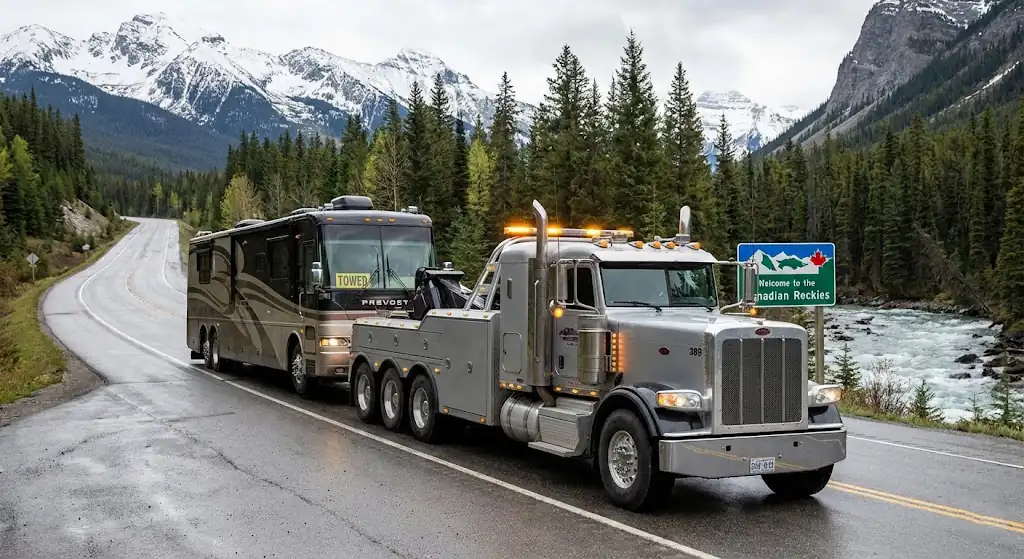
At Quebec Remorquage, our heavy duty towing fleet is built for exactly this. This guide covers everything you need to know about RV towing in Quebec — what to tell the dispatcher, what it costs, which truck types handle which RVs, and how to prepare so help arrives with the right equipment on the first trip.
What to Tell the Dispatcher Before an RV Tow
RV towing requires more information than a standard car tow. Giving the dispatcher these details ensures the right truck arrives on the first trip:
- RV type — Class A motorhome, Class B van, Class C motorhome, travel trailer, fifth wheel, or pop-up camper
- Approximate length — a 22-foot Class C and a 40-foot Class A require very different equipment
- GVWR (Gross Vehicle Weight Rating) — found on the RV’s door sticker or in the manual. This determines the truck class needed
- What happened — mechanical breakdown, blowout, engine overheat, accident, stuck, or out of fuel
- Is it a motorhome or a towable? — motorhomes (Class A/B/C) have engines and drive under their own power. Towables (travel trailers, fifth wheels) are pulled by a truck
- Slideouts retracted? — extended slideouts change the RV’s width and must be retracted before towing for road clearance
- Your exact location — GPS pin, highway marker, campground name, or address
- Destination — RV dealer, mechanic specializing in RVs, campground, storage, or your home
💡 Know Your GVWR: The single most important number for RV towing is the Gross Vehicle Weight Rating. Write it down and keep it in your phone notes. A 10,000 lb (4,500 kg) GVWR requires a medium-duty truck. A 30,000 lb (13,600 kg) GVWR requires a heavy-duty wrecker. Sending the wrong capacity truck means starting over — wasting hours and potentially doubling the cost.
RV Types and Their Towing Requirements
Each RV type presents different towing challenges. Here is how they break down:
🚌 Class A Motorhome
The largest RVs on the road — 26 to 45 feet, 10,000 to 30,000+ lbs. Built on bus or truck chassis. Requires heavy-duty wrecker with 25+ ton capacity. Dual rear axles and air brakes add complexity.
Truck needed: Heavy-duty wrecker
🚐 Class C Motorhome
Built on a truck or van chassis (Ford E-450, Chevy 4500) — 22 to 33 feet, 10,000 to 16,000 lbs. Over-cab sleeping area adds height. Requires medium to heavy-duty truck depending on weight.
Truck needed: Medium or heavy-duty
🚙 Class B Camper Van
Built on a standard van chassis (Mercedes Sprinter, Ram ProMaster) — 17 to 23 feet, 8,000 to 11,000 lbs. Similar size to a large cargo van. Can often use a standard flatbed truck.
Truck needed: Large flatbed or medium-duty
🏕️ Travel Trailer
Towed behind a truck or SUV — 15 to 35 feet, 3,000 to 10,000 lbs. If the tow vehicle breaks down, both the vehicle and trailer may need transport. Flat tires on trailers are common.
Truck needed: Depends on whether trailer or tow vehicle failed
🔗 Fifth Wheel
Connects to a hitch in the truck bed — 22 to 40 feet, 7,000 to 16,000 lbs. Must be disconnected from the tow vehicle before towing. Specialty dolly or Landoll trailer may be needed for transport.
Truck needed: Heavy-duty with Landoll or dolly system
⛺ Pop-Up / Truck Camper
Lightweight (1,500 to 5,000 lbs). Pop-up trailers can usually be towed with a standard truck. Truck campers ride on the truck bed — if the truck breaks down, both go together on a flatbed.
Truck needed: Standard flatbed or medium-duty
RV Towing Costs in Quebec (2026)
RV towing costs more than passenger vehicle towing because of the larger trucks, heavier equipment, and additional time required. Here are typical Quebec ranges:
*Prices vary by RV weight, distance, time, and recovery complexity. Call (418) 476-1522 for exact quotes. Full pricing at our towing cost guide.
Why the wide price range? A Class B camper van tow is similar in complexity to towing a large SUV. A Class A motorhome recovery from a ditch requires a heavy wrecker, possibly a rotator, cleanup of spilled fluids, and hours of specialized work. The dispatcher’s ability to send the right equipment on the first trip — which depends on the details you provide — is the biggest factor in keeping costs down.
Most Common RV Breakdowns in Quebec
Understanding why RVs break down helps you prepare — and tells the dispatcher what to expect:
- Tire blowouts — The number one RV towing call. RV tires carry enormous loads, heat up on long highway drives, and are frequently under-inflated. Quebec’s pothole-heavy roads multiply the risk. Many RV owners have never checked their tire pressures since purchase.
- Engine overheating — Motorhomes work hard climbing Quebec’s hills, towing heavy loads with A/C running. Cooling systems that are adequate for flat highway driving fail on the hills between Quebec City and Charlevoix or the Laurentians.
- Transmission failure — The extreme weight of a loaded motorhome stresses automatic transmissions. Overheated transmission fluid leads to slipping, shuddering, and eventually failure. Towing must be on a flatbed or with a Landoll trailer.
- Electrical system failures — RVs have complex dual electrical systems (chassis and house). Generator failures, converter problems, or chassis battery death can leave the vehicle stranded.
- Brake issues — Heavy vehicles with worn brakes are dangerous on Quebec’s hilly terrain. Brake fade on long descents or complete brake failure requires immediate towing.
- Fuel system problems — Diesel motorhomes can develop fuel filter clogs, injector issues, or fuel gelling in winter. Gasoline models can vapour-lock in extreme summer heat.
For overheating-specific guidance, read our post-accident towing guide. For general breakdown safety while waiting, see our stranded driver safety guide.
Heavy Duty RV Towing • 24/7 • All Classes
Class A, B, C motorhomes • Travel trailers • Fifth wheels • Heavy wrecker fleet
Tow Vehicle Broke Down While Pulling a Trailer?
One of the most complex RV towing scenarios is when the tow vehicle (truck or SUV) breaks down while pulling a travel trailer or fifth wheel. Now you have two vehicles to deal with:
- Option 1: Tow both together. If the tow vehicle can still roll safely (dead battery, minor electrical issue), a heavy wrecker may be able to tow the truck-and-trailer combination as one unit. This is the cheapest option when possible.
- Option 2: Separate and tow individually. The trailer is disconnected and stabilized with levelling jacks. The tow vehicle goes on a flatbed. The trailer is either left at a secure location (campground, parking lot) for later retrieval, or a second truck moves it separately.
- Option 3: Tow vehicle to mechanic, trailer to storage. The broken vehicle goes to a shop, and we move the trailer to a campground, storage facility, or your home. This avoids leaving an expensive trailer roadside overnight.
Tell the dispatcher about both vehicles. Mention the trailer’s length, weight, and hitch type (bumper pull or fifth wheel). This determines whether we send one truck or two. Our operators are experienced at disconnecting trailers safely — including fifth wheels with their more complex coupling systems.
Quebec-Specific RV Towing Challenges
Quebec’s roads and climate create unique challenges for RV towing that do not exist in other provinces. According to the SAAQ, RVs are involved in a disproportionate number of roadside incidents on Quebec highways:
- Bridge height restrictions — Some Quebec bridges and underpasses have clearance limits that tall RVs (Class A motorhomes can be 12–13 feet) cannot pass under. A tow route must account for these restrictions — the fastest route is not always the legal route for an oversized load.
- Narrow rural roads — Routes to campgrounds in Charlevoix, the Laurentians, and Gaspésie include narrow, winding roads where manoeuvring a heavy wrecker with a 40-foot motorhome requires experienced operators.
- Pothole damage — Quebec’s freeze-thaw cycle creates potholes that are brutal on RV tires and suspension. Spring pothole season (March–May) is peak RV tire blowout season.
- Seasonal traffic — Summer weekends and holiday periods create heavy traffic on routes to popular camping areas. Breakdowns in congested areas require traffic management during the tow.
- Winter storage issues — RVs left in inadequate winter storage can sustain water damage, frozen pipes, and rodent damage that make them undriveable in spring, requiring a tow to a repair facility.
For more on Quebec road conditions and seasonal preparation, see our winter breakdown safety guide and our post-winter checkup guide.
How to Prevent RV Breakdowns on Quebec Roads
An RV tow is expensive and disrupts your trip. These maintenance habits keep you on the road:
- Check tire pressure before every trip — RV tires should be inflated to the pressure listed on the sidewall, not the door sticker (which is for the chassis). Use a quality gauge and check when cold.
- Replace RV tires every 5–7 years regardless of tread depth — RV tires degrade from sun, ozone, and age even with low mileage. Check the DOT date code on the sidewall.
- Service the transmission annually — Fluid changes and filter replacements are cheap insurance against the $3,000–$6,000 transmission failure that heavy loads cause.
- Inspect the cooling system before summer — flush coolant, check hoses, verify the radiator fan works. Quebec summer heat plus hills plus A/C equals maximum cooling system stress.
- Test house and chassis batteries — weak chassis batteries cause starting failures. Weak house batteries cause generator and electrical issues that leave you stranded.
- Retract slideouts and secure contents before driving — extended slideouts catch on obstacles and add wind resistance. Loose items inside shift during driving, causing damage and imbalance.
- Keep a complete emergency kit — including the RV’s GVWR written down, a charged phone with tow company numbers saved, reflective triangles, and a basic tool set. See our winter survival kit guide.
RV Insurance and Towing Coverage in Quebec
RV-specific insurance policies often include towing coverage — but the coverage limits may not match the actual cost of heavy duty towing:
- Check your towing coverage limit. A standard $200 towing limit barely covers the dispatch fee for a heavy wrecker. RV-specific policies should offer $1,000–$3,000+ in towing coverage to realistically cover a Class A or C recovery.
- Verify coverage for both vehicles. If you tow a trailer with a truck, check whether both the truck and trailer are covered for towing — they may be on separate policies.
- Accident towing is usually fully covered. Post-accident RV towing falls under collision coverage and is typically reimbursed in full. Quebec Remorquage can arrange direct billing with your insurer through our insurance towing service.
- Roadside assistance add-ons vary. Some RV policies include roadside assistance. Others require a separate membership (Good Sam, Coach-Net, or CAA RV). Verify before your trip — not after you are stranded.
Quebec Remorquage works with all major insurers for RV towing claims. Ask our dispatcher about direct billing when you call — it can save you from paying $500–$1,500 out of pocket and filing a claim later.
Full Heavy Duty and Roadside Services
RV issues go beyond towing. Quebec Remorquage’s full service lineup covers every RV emergency:
- Motorhome in a ditch? Winching recovery with heavy-duty capacity
- RV battery dead? Battery boost for chassis batteries
- RV tire blowout? Tire change if a spare is carried, or tow to an RV tire shop
- RV accident? Accident towing with insurance coordination
- Long-distance RV transport? Long-distance heavy towing
- End-of-life RV? Scrap vehicle removal
- Car or truck breakdown too? Breakdown towing and flatbed towing
All services 24/7 across the Quebec City service area — Sainte-Foy, Beauport, Charlesbourg, Limoilou.
Frequently Asked Questions
How much does RV towing cost in Quebec?
RV towing ranges from $200 to $1,500+ depending on the RV’s size, weight, distance, and recovery complexity. A Class B or small trailer local tow starts around $200. A Class A motorhome recovery from a ditch can exceed $2,000. Call (418) 476-1522 with your RV’s type, length, and weight for an exact quote.
Can a regular tow truck tow an RV?
Only small Class B camper vans and lightweight pop-up campers can be handled by a standard flatbed. Class A and C motorhomes, fifth wheels, and large travel trailers require medium or heavy-duty wreckers rated for their weight. Sending a standard truck to a heavy RV wastes time and puts the operator at risk.
What is the GVWR and why does it matter for towing?
GVWR (Gross Vehicle Weight Rating) is the maximum loaded weight of your RV as specified by the manufacturer. It determines which tow truck class is needed. A tow truck must have a rated capacity exceeding your RV’s GVWR to safely transport it. You can find the GVWR on the sticker inside your RV’s entry door or in the owner’s manual.
Is RV towing available 24/7?
Yes. Quebec Remorquage provides RV and heavy-duty towing 24 hours a day, 7 days a week. RV breakdowns often happen during weekend trips and holiday travel — we maintain heavy wrecker availability during these peak periods.
What if my truck breaks down while towing a trailer?
Tell the dispatcher about both vehicles. We may tow the truck-and-trailer combination together if feasible, or disconnect the trailer and tow them separately. The trailer can be moved to a nearby campground, storage lot, or your home while the truck goes to a mechanic. We handle the disconnection safely.
Does insurance cover RV towing?
Most RV-specific insurance policies include towing coverage, but limits vary widely. Standard auto policies may only cover $200, which is insufficient for heavy-duty towing. Check your policy for the towing limit and consider increasing it if you own a Class A or C motorhome. After an accident, towing is typically covered in full under collision coverage.
Do I need to retract the slideouts before towing?
Yes. Extended slideouts increase the RV’s width beyond legal road limits and create wind drag, instability, and collision risk with passing traffic, signs, and bridge structures. If the slideouts cannot be retracted (power failure), the tow operator may be able to manually crank them in — most slideouts have an emergency manual override.
Can you tow an RV from a campground?
Yes. We tow from campgrounds, RV parks, rural lots, and private properties. Access may be limited by narrow campground roads, overhanging trees, and tight turns — describe the access conditions when you call so we send the right-sized equipment. In some cases, a smaller truck may need to reposition the RV to a main road before the heavy wrecker can load it.
Where should I have my RV towed for repairs?
Tow to an RV-certified repair facility or dealer — not a standard auto mechanic. RVs have specialized systems (propane, house electrical, slide mechanisms, generators) that general mechanics are not equipped to diagnose or repair. Quebec City has several RV service centres — ask our dispatcher for recommendations when you call.
What if my RV has a flat tire but no spare?
Many RVs, especially travel trailers and fifth wheels, do not carry spare tires. If a roadside tire change is not possible, the RV must be towed to a tire shop that stocks RV-specific tires (different size and load rating from passenger tires). Specify the tire size when calling so we can confirm the destination shop has the right replacement.
RV Breakdown? We Bring the Right Truck. Every Time.
24/7 heavy duty RV towing across Quebec City and surrounding areas.
Class A, B, C motorhomes. Travel trailers. Fifth wheels. All sizes, all weights.