Winching & Vehicle Recovery: Getting Unstuck in Quebec
⚡ Quick Answer
A winch out service uses a steel or synthetic cable connected to a tow truck’s power winch to pull your vehicle free from snow, mud, ditches, embankments, or off-road terrain — without towing it away. Once unstuck, you drive home under your own power.
Cost in Quebec: $125–$350+ | Time on site: 10–45 minutes | Available: 24/7
Your tires spin in place. The car sinks deeper with every attempt. You are stuck — and no amount of rocking back and forth, cardboard under the wheels, or frustrated gas pedal stomping is going to get you free. Whether you slid into a ditch on Boulevard Laurier after freezing rain, buried your SUV in a snowbank leaving a Charlesbourg shopping centre, or got your truck bogged in mud on a rural road near Beauport, you need a professional winch out service.
Vehicle winching is one of the most common roadside calls in Quebec — especially from November through April when snow, ice, and slush make getting stuck an almost daily occurrence across the province. The difference between a DIY recovery attempt and a professional winch out service is the difference between driving away in 15 minutes and spending hours making the situation worse.
At Quebec Remorquage, our winching and vehicle recovery service is available 24/7 with trucks equipped for everything from a sedan in a shallow ditch to a heavy truck buried axle-deep in mud. This guide covers how winching works, what it costs, when you need it, and how to stay safe until help arrives.
What Is a Winch Out Service?
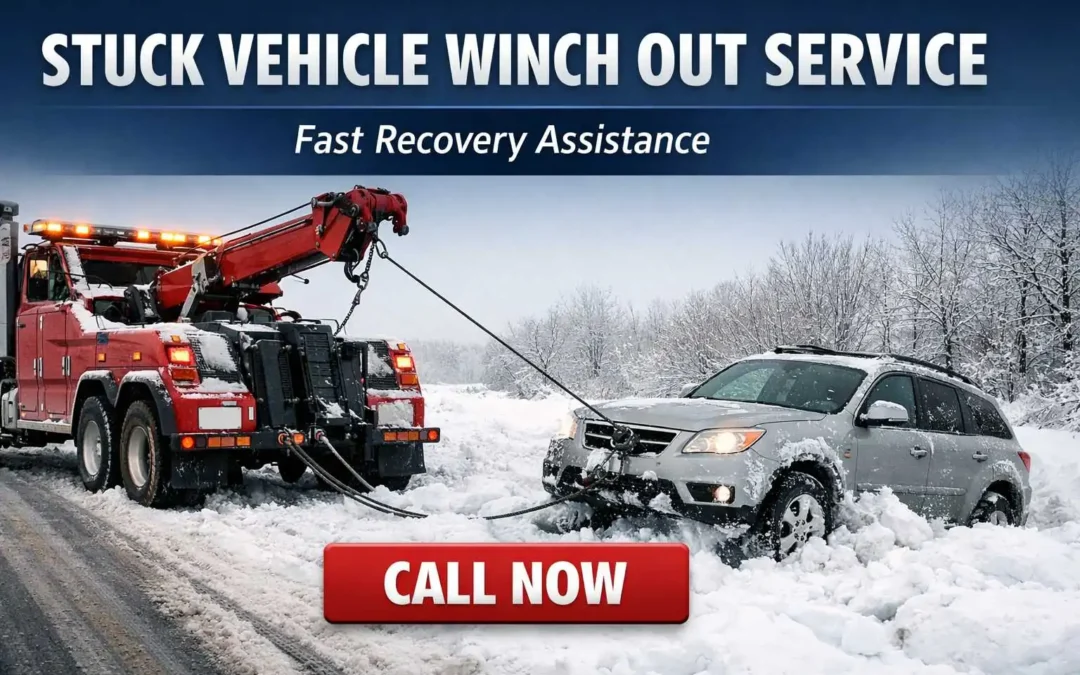
A winch out service is a vehicle recovery method that uses a motorized winch — a high-powered drum with a steel or synthetic cable — mounted on a tow truck. The cable is attached to your stuck vehicle’s frame or designated recovery point, and the winch slowly pulls it free from whatever it is trapped in.
The critical distinction: winching recovers your vehicle to driveable ground — it does not tow it away. Once free, you inspect the car for damage, and if everything looks good, you drive away. No tow truck bill. No mechanic trip. Just a fast extraction and you are on your way.
If the vehicle sustained damage during the incident (bent wheel, broken axle, fluid leak), winching is still the first step — we extract it to safe ground, then transition to a breakdown tow to your mechanic.
How Professional Winching Works — Step by Step
When you call Quebec Remorquage for a winch out, here is the process our operators follow to get you unstuck safely:
Scene assessment. The operator evaluates your vehicle’s position, the terrain, ground stability, and the safest angle of pull. This prevents secondary damage — pulling from the wrong angle can drag the vehicle into a worse position.
Tow truck is positioned and anchored. The operator parks the truck on solid ground and engages the parking brake, outriggers, or wheel chocks. The truck must be completely stable — it becomes the fixed anchor point for the entire pull.
Winch cable is attached to your vehicle. A hook or D-ring is connected to the vehicle’s frame-mounted recovery point — never to the bumper, axle, or tow hitch alone. A protective blanket may be draped over the cable as a safety measure in case it snaps under load.
Controlled, slow pull. The winch retracts the cable at a steady, controlled speed. The operator monitors the cable tension, angle, and vehicle movement continuously. You may be asked to steer or apply gentle throttle to assist the extraction.
Vehicle is recovered to solid ground. Once free, the operator places the vehicle on stable, flat ground. A quick inspection checks for undercarriage damage, fluid leaks, and tire condition before you drive away.
💡 Pro Tip: When you call, describe exactly what happened — “slid into a ditch,” “stuck in snow up to the bumper,” “rear wheels off the shoulder.” This helps the dispatcher send the right winch capacity and equipment on the first trip, avoiding delays.
Common Winching Scenarios in Quebec
Quebec’s climate and terrain create a wide variety of situations where a winch out service is the only safe solution. Here are the most common calls we handle:
❄️ Snow & Ice Stuck
The most common Quebec recovery. Vehicles slide off roads, get buried in snowbanks, or lose traction on unplowed streets. Happens thousands of times per winter across the province.
🕳️ Ditch & Shoulder Recovery
Vehicles slide off the road into ditches, drainage channels, and soft shoulders. Common on rural Quebec roads and autoroute on-ramps with limited guardrails.
🌧️ Mud & Soft Ground
Spring thaw, construction sites, unpaved driveways, and rural lots turn into mud traps. Vehicles sink past the tires and self-recovery becomes impossible.
🏔️ Embankment & Hill Slides
Steep driveways, parking garage ramps, and hilly Quebec streets cause vehicles to slide backward or sideways. Winching from above or below recovers them safely.
🅿️ Parking Lot Stuck
Unplowed parking lots, curb-mounted snowbanks, and icy ramps trap vehicles regularly from December through March. A quick winch out gets you free in minutes.
🌳 Off-Road & Trail Recovery
ATVs, trucks, and SUVs that venture off established roads may get stuck in deep ruts, swamps, or rocky terrain requiring heavy-duty winching equipment.
Winch Out Service Costs in Quebec (2026)
Winch out service pricing depends on the vehicle size, how deeply it is stuck, terrain difficulty, and time of day. Here are typical ranges for Quebec in 2026:
*Prices vary by vehicle weight, recovery complexity, terrain, and time of day. Call (418) 476-1522 for exact quotes. See our complete towing cost guide for full pricing details.
A professional winch out almost always costs less than a tow — because you drive away under your own power. For a simple snowbank extraction, the cost can be as low as $125 — far less than the body damage from a failed DIY attempt or the towing bill if your self-recovery attempt causes mechanical damage.
Winching vs Towing: What Is the Difference?
Drivers sometimes confuse winching and towing, but they solve different problems. Understanding the difference ensures you request — and pay for — only the service you actually need.
🔗 Winch Out (Recovery)
- Pulls vehicle to driveable ground
- You drive away after extraction
- No transport to another location
- Faster and usually cheaper
- Resolves: stuck, ditch, off-road
Cost: $125–$600+
🚛 Towing (Transport)
- Moves vehicle to a new location
- Vehicle loaded onto or behind truck
- Transport to mechanic, home, dealer
- Needed when vehicle cannot drive
- Resolves: breakdown, accident, dead
Cost: $150–$600+
Sometimes you need both. If your vehicle slid into a ditch and sustained damage that prevents driving, we first winch it free, then load it onto a flatbed or wheel lift for transport. Quebec Remorquage bundles both services into a single bill with transparent pricing — you never pay separately for two dispatches.
Stuck Right Now? We Pull You Free.
24/7 winch out service across Quebec City • From $125 • All vehicle types
Why DIY Recovery Attempts Often Make Things Worse
The temptation to “just try one more time” is powerful — but without proper equipment and technique, self-recovery attempts frequently escalate a minor stuck into a major problem:
- Spinning wheels dig deeper. Every time you floor the accelerator on a stuck vehicle, the tires excavate themselves further into snow, mud, or sand. What started as a tire-deep stuck becomes a bumper-deep stuck.
- Rocking damages the transmission. Rapidly shifting between Drive and Reverse stresses the automatic transmission and can overheat the fluid — a repair that costs $2,000 to $5,000.
- Tow straps between vehicles are dangerous. A strap that breaks under load becomes a deadly projectile. Without proper recovery points, the strap can also rip off bumpers, crack plastic, or bend the frame on the helper vehicle.
- Jacking on soft ground fails. Placing a jack in snow or mud without a solid base can cause the vehicle to collapse off the jack — a serious injury risk.
- Driving out on a flat tire destroys the wheel. If a ditch slide caused a flat, driving on the rim to “get to the road” grinds down the wheel and creates a $300+ replacement instead of a simple tire change.
⚠️ Safety Warning: Never crawl under a stuck vehicle to attach ropes, chains, or jacks. Unstable ground can shift, the vehicle can move, and the risk of being crushed is real. A professional winch out service uses cable and remote controls — the operator never places themselves beneath the vehicle during extraction.
Quebec Roads and Weather: Why Winching Is So Common Here
Quebec’s climate makes vehicle recovery a year-round necessity — not just a winter service. According to SAAQ data, thousands of vehicles leave the roadway each year in Quebec due to weather-related conditions.
Winter (November–March): Black ice, freezing rain, snowdrifts, and unplowed side streets make getting stuck a near-certainty for many drivers. Snowplow banks along residential streets create walls that trap vehicles attempting to park. Our 24/7 emergency dispatch sees peak winching volume during winter storms and the days immediately after.
Spring (April–May): The thaw turns shoulders, ditches, and unpaved areas into soft mud traps. Vehicles that drove safely on frozen ground all winter suddenly sink when temperatures rise. Quebec’s spring pothole season also causes blowouts that send cars into ditches.
Summer (June–August): Heavy rainstorms flood low-lying roads and parking areas. Vehicles attempting to drive through standing water stall and become stranded. Off-road adventures on ATV trails and cottage access roads also create summer recovery calls.
Fall (September–October): Wet leaves on roads reduce traction dramatically. Early frost before winter tire season catches drivers off guard. For tips on preparing your car for seasonal changes, read our post-winter vehicle checkup guide and winter breakdown safety guide.
What to Do While Stuck — Before Help Arrives
While waiting for a winch out service, your priority is safety — especially in winter or on busy roads:
- Turn on hazard lights immediately — even during the day, even in a parking lot
- Stay inside the vehicle if on a roadside — standing near a stuck car on a highway is extremely dangerous, especially in low visibility
- Do not keep spinning your wheels — stop as soon as you realize you are stuck. Each attempt digs you deeper
- Set reflective triangles or flares if available and if it is safe to exit the vehicle
- Call for help and share your location — use Google Maps or a landmark. Read our full guide on what to do while waiting for help in Quebec
- If the engine is running in snow, check the exhaust pipe — snow blocking the tailpipe can cause carbon monoxide to enter the cabin. Clear it or crack a window
Keeping a winter driving survival kit in your vehicle ensures you have warm clothing, a phone charger, a flashlight, and warning triangles if you ever get stranded.
More Than Winching: Full Recovery Support
Getting unstuck is sometimes just the beginning. Quebec Remorquage’s complete service lineup handles whatever comes next:
- Flat tire after a ditch slide? Our tire change service installs your spare on the spot
- Battery died while stuck? Our battery boost gets you started immediately
- Vehicle damaged and undriveable? We transition to flatbed towing on the same call
- Accident caused the ditch slide? Our accident towing includes insurance coordination
- Heavy truck or RV stuck? Our heavy-duty towing fleet handles vehicles over 10,000 lbs
- Keys locked inside? Our car unlocking service opens your door without damage
Everything is available 24/7 across our full Quebec City service area — including Limoilou, Sainte-Foy, and Charlesbourg. No membership required.
Frequently Asked Questions
How much does a winch out cost in Quebec?
A standard winch out from a snowbank or shallow ditch typically costs $125 to $200 in the Quebec City area. More complex recoveries — deep mud, embankments, off-road terrain — range from $200 to $600+. Heavy vehicle recoveries start at $400. Quebec Remorquage provides exact quotes before dispatch.
Is winching the same as towing?
No. Winching pulls your vehicle free from where it is stuck and places it on driveable ground. Towing transports your vehicle to another location on a truck. After a winch out, you drive away on your own. If the vehicle is damaged and cannot drive, winching is the first step before towing to a mechanic.
Can you winch a car out of a ditch?
Yes. Ditch recoveries are one of our most common calls. The operator assesses the angle, attaches the winch cable to your vehicle’s recovery point, and pulls it back onto the road surface. Most ditch winch outs take 10 to 30 minutes depending on depth and terrain.
Will winching damage my car?
Professional winching using proper recovery points and controlled cable tension causes no damage to your vehicle. The risk comes from DIY attempts that attach ropes to bumpers, axles, or non-structural parts. Our operators always connect to manufacturer-designated recovery points or frame-mounted hooks.
Is winch out service available 24/7?
Yes. Quebec Remorquage provides winch out service 24 hours a day, 7 days a week, including holidays and during storms. Winter snowstorms and freezing rain events generate the highest volume of winching calls — we maintain full staffing during severe weather.
Can I use my car’s tow hitch as a winch point?
A tow hitch receiver can sometimes be used, but it is not always the best attachment point. Factory recovery hooks (usually located behind small plastic covers on the front bumper) are designed specifically for this purpose and are stronger. Our operator will select the safest attachment point based on your specific vehicle.
What if my car is stuck AND damaged?
We handle both in a single service call. The operator first winches your vehicle to solid ground, then inspects it. If the vehicle cannot safely drive — flat tire, bent wheel, fluid leak, suspension damage — we load it onto a flatbed and tow it to your preferred mechanic. The winch out and tow are billed together at a bundled rate.
Can you winch a truck or SUV?
Yes. Our standard service trucks carry winches rated for passenger vehicles up to light trucks and SUVs. For heavier vehicles — commercial trucks, RVs, and equipment — we dispatch heavy-duty recovery trucks with 25 to 50+ ton winch capacity. Tell the dispatcher your vehicle type so we send the right equipment.
Does insurance cover winch out service?
Many auto insurance policies include roadside assistance coverage that may cover winching. If the winch out follows an accident, it is typically included in the accident towing coverage. Check your policy for details or ask our dispatcher — we work with major insurers and can assist with the claims process.
Should I try to dig my car out before calling?
If you have a shovel and can safely clear snow from around the tires without standing in traffic, a small amount of digging can help. But if the vehicle is deeply stuck, high-centred on a snowbank, or in a ditch, further attempts usually worsen the situation. Call first — a professional extraction is faster, safer, and prevents the secondary damage that self-recovery attempts often cause.
Stuck? Stop Spinning. Start Calling.
24/7 winch out and vehicle recovery across Quebec City.
Snow, mud, ditches, embankments — from $125. All vehicle types. Upfront pricing.