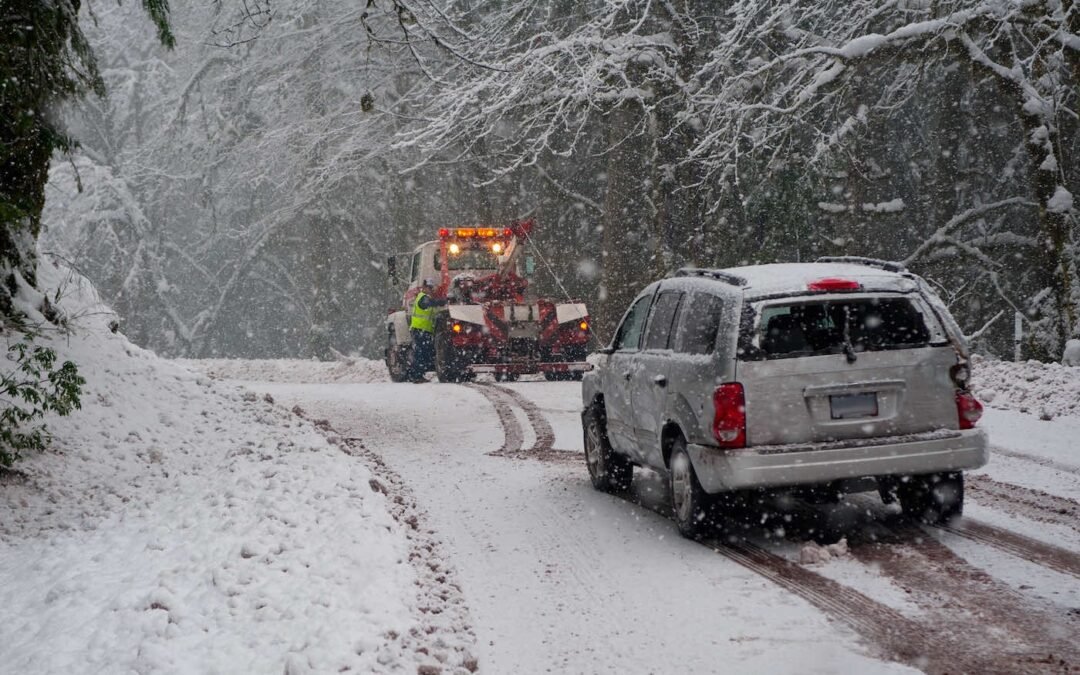
Getting stuck in snow is one of the most frustrating and avoidable winter problems Quebec drivers face. While we’ve covered what to do when you’re already stuck, prevention is always better than calling for a winch-out service. With the right preparation, driving techniques, and awareness, you can dramatically reduce your chances of getting stuck this winter.
In this guide, you’ll learn proven techniques to prevent your vehicle from getting stuck in Quebec’s snow and ice, from choosing the right tires to mastering snow driving skills that keep you moving safely all winter long.
Why Cars Get Stuck in Quebec Snow
Understanding why vehicles get stuck helps you avoid the conditions that lead to these situations. The most common causes include insufficient ground clearance when driving through deep snow, loss of traction on ice or packed snow, poor tire choice or worn tread, attempting to park or drive in unplowed areas, and aggressive acceleration that causes wheelspin instead of forward motion.
Quebec’s winter conditions are particularly challenging because temperatures fluctuate frequently, creating layers of ice beneath fresh snow, unpredictable traction, and constantly changing road surfaces. Add narrow city streets, parking lot snow piles, and residential areas that may not be plowed immediately, and you have countless opportunities to get stuck if you’re not prepared.
10 Proven Ways to Prevent Getting Stuck in Snow
1. Install Proper Winter Tires (Mandatory in Quebec)
This isn’t just good advice—it’s the law. Quebec requires winter tires from December 1 to March 15 for good reason: they make an enormous difference in snow traction.
Look for tires with the three-peaked mountain snowflake symbol, not just M+S markings. Winter tires are made from rubber compounds that stay flexible in cold temperatures, providing grip when all-season tires turn hard and lose traction. The tread patterns are specifically designed to channel snow and water away while biting into slippery surfaces.
For maximum traction, install winter tires on all four wheels, not just the drive wheels. Mismatched tires create unpredictable handling that can leave you stuck or sliding. Check your tread depth regularly—winter tires should have at least 4.8mm of tread (the legal minimum), though 6mm is recommended for optimal performance.
Maintain proper tire pressure throughout winter. Cold temperatures cause pressure to drop about 1 PSI for every 5°C decrease in temperature. Under-inflated tires reduce traction and increase your chances of getting stuck.
2. Add Weight to Your Vehicle (For Rear-Wheel Drive)
If you drive a rear-wheel-drive vehicle—pickup trucks, vans, or some sedans—adding weight over the drive wheels improves traction significantly. Place sandbags, kitty litter bags, or salt bags in the trunk or truck bed directly over the rear axle.
Use 100-150 pounds of weight for smaller vehicles, or 200-300 pounds for trucks. The added weight presses your drive tires harder against the road surface, increasing grip on snow and ice. As a bonus, the sand or kitty litter serves as emergency traction material if you do get stuck.
Front-wheel and all-wheel drive vehicles already have engine weight over the drive wheels, so added weight provides minimal benefit and may actually reduce fuel economy unnecessarily.
3. Keep Your Gas Tank Above Half Full
A half-full or fuller gas tank serves multiple purposes in winter. Fuel adds weight that improves rear traction, especially in rear-wheel-drive vehicles. A fuller tank prevents fuel line freeze-ups caused by condensation in near-empty tanks. If you do get stuck, you’ll have plenty of fuel to run the engine periodically for heat while waiting for help.
The extra fuel also provides ballast that helps vehicle stability in slippery conditions, making it easier to maintain control and avoid situations where you’d get stuck.
4. Clear All Snow From Your Vehicle Before Driving
This seems obvious, but many drivers skip this step and regret it. Clear all snow from your hood, roof, windows, lights, and license plates before driving. Snow on your hood can blow back onto your windshield, blocking visibility at exactly the wrong moment. Roof snow slides onto your windshield when you brake, or worse, onto the car behind you.
Snow and ice on headlights and taillights reduce visibility for you and other drivers, creating dangerous conditions. Most importantly for avoiding getting stuck, clean snow away from around your wheels and undercarriage—accumulated snow and ice can reduce ground clearance and cause you to get high-centered.
5. Avoid Driving Through Deep or Unpacked Snow
Your vehicle has a specific ground clearance—the distance between the road and your vehicle’s lowest point. Driving through snow deeper than your ground clearance causes you to get “high-centered,” where the vehicle’s undercarriage rests on packed snow while the wheels spin uselessly in the air.
Most passenger vehicles have 6-8 inches of ground clearance. SUVs and trucks may have 8-12 inches. Know your vehicle’s limits and avoid driving through snow that approaches or exceeds these depths. If you must cross deep snow, look for tire tracks from other vehicles that have already packed down a path.
When parking, choose spots that have been plowed or cleared. Don’t attempt to drive over snowbanks or through piles left by plows—these are often much harder and deeper than they appear.
6. Master Gentle Acceleration and Smooth Driving
Aggressive driving is the fastest way to get stuck in snow. Sudden acceleration causes wheelspin, which polishes snow into slippery ice beneath your tires, digging you deeper instead of moving forward.
Accelerate gently and progressively, giving your tires time to find and maintain grip. In manual transmission vehicles, start in second gear to reduce torque and prevent wheelspin. In automatic vehicles, use “snow mode” if available, or manually select a higher gear for reduced torque.
Apply the same principle to steering and braking. Smooth inputs keep your tires gripping rather than sliding. Jerky movements break traction and can leave you stuck sideways in a parking spot or unable to climb a gentle incline.
7. Build Momentum Before Hills, Then Maintain Speed
Trying to accelerate uphill on snow is a recipe for getting stuck. Instead, build momentum on flat ground before you reach the hill, then maintain steady speed as you climb. Don’t accelerate mid-hill—this often causes wheelspin and loss of traction.
Similarly, don’t stop on hills if you can avoid it. Coming to a complete stop on an incline makes it extremely difficult to get moving again in slippery conditions. If you see a red light or stopped traffic ahead on a hill, slow down early and keep rolling slowly until the way clears, rather than stopping completely and struggling to restart.
8. Choose Your Parking Spots Wisely
Where you park matters as much as how you drive. Choose plowed parking spots over snow-covered areas whenever possible. Avoid parking on inclines—if snow falls while you’re parked, you may not be able to drive out. Park in the direction you’ll want to exit, reducing the need for reversing and maneuvering in snow.
If you must park in unplowed areas, clear a space for your vehicle and create an exit path. Spend two minutes shoveling now rather than twenty minutes getting unstuck later. When parallel parking in winter, leave extra space in front and behind—you’ll need room to rock the vehicle if you get stuck.
9. Engage Four-Wheel or All-Wheel Drive Properly
If your vehicle has 4WD or AWD, use it correctly. Four-wheel drive helps you get moving and maintain traction, but it doesn’t help you stop faster or corner better—those depend on your tires and driving skill.
Engage 4WD before you need it, not after you’re already stuck or sliding. In deep snow, use low-range 4WD if available for maximum torque and control. Remember that 4WD increases your capability but not your invincibility—even 4WD vehicles get stuck if driven carelessly.
Don’t rely solely on 4WD to compensate for poor tires or aggressive driving. The best approach combines proper tires, skilled driving, and 4WD when needed.
10. Avoid Sudden Stops and Direction Changes
Maintaining momentum is key to preventing getting stuck. Plan ahead to avoid sudden stops—each time you stop completely in deep snow, you risk getting stuck when trying to move again. Time traffic lights, approach intersections slowly enough to keep rolling, and maintain safe following distances so you’re not forced to stop abruptly.
Direction changes also break traction. When turning in snow, slow down before the turn, make smooth steering inputs, and accelerate gently after you’ve straightened out. Sharp turns at speed can leave you stuck sideways or send you sliding into a snowbank.
Winter Driving Techniques for Quebec Roads
Beyond general prevention strategies, specific driving techniques help you handle Quebec’s unique winter conditions.
Dealing With Icy Intersections
Intersections become polished ice from repeated braking and acceleration. Approach slowly and brake well before the intersection while you still have traction. If you feel your wheels locking or sliding, release the brake and try again with gentler pressure. Use engine braking (downshifting) to slow down instead of relying solely on brakes.
Navigating Residential Streets
Many Quebec neighborhoods aren’t plowed immediately after snowfall. When driving on unplowed residential streets, stick to existing tire tracks where possible—other vehicles have already packed down the snow, providing better traction than virgin snow. Drive slowly enough that you can react to hidden obstacles or icy patches, but maintain enough momentum to avoid getting stuck.
Highway Driving in Winter Weather
Highways are generally better maintained than side streets, but they present their own challenges. Stay in the right lane where road conditions are typically better (left lanes see less traffic and may have more snow accumulation). Avoid passing unnecessarily—lane changes in winter require careful judgment. Reduce speed and increase following distance to five to six seconds, giving yourself time to react to changing conditions.
Essential Winter Emergency Kit
Even with perfect prevention, Quebec winters can surprise you. Keep these items in your vehicle from November through April:
Getting Unstuck Tools
- Folding shovel for clearing snow around tires
- Bag of sand, salt, or kitty litter for traction
- Traction mats or boards to place under drive wheels
- Tow strap rated for your vehicle’s weight
Safety and Comfort
- Heavy blankets or sleeping bag
- Extra winter clothing (coat, gloves, hat, boots)
- Bottled water and high-energy snacks
- Flashlight with extra batteries
- First aid kit
- Portable phone charger (fully charged)
Vehicle Maintenance Items
- Ice scraper and snow brush
- Jumper cables or portable battery booster
- Basic tool kit
- Reflective warning triangles
- Windshield washer fluid (winter formula)
For more detailed emergency preparation, see our guide on what to do when your car breaks down in winter.
When Conditions Are Too Dangerous to Drive
Sometimes the best prevention is staying home. Don’t drive in these conditions:
- Whiteout conditions where visibility drops below 100 meters
- Freezing rain or ice storms that coat roads in solid ice
- Extreme cold warnings (below -35°C) when vehicles are prone to breakdown
- Heavy snowfall (5+ cm per hour) before plows can clear roads
- Travel advisories issued by Quebec authorities
Check weather forecasts and road conditions before driving. Quebec’s 511 service provides real-time road condition updates. If authorities advise against travel, take their advice seriously—getting stuck in dangerous weather can quickly become life-threatening.
Pre-Winter Vehicle Preparation
Preventing stuck vehicles starts before winter arrives. Complete these tasks in late October or early November:
- Install winter tires early: Don’t wait until the first snowfall
- Check battery health: Cold weather is hard on batteries—replace weak ones proactively
- Test your heater and defroster: These are essential for visibility and comfort
- Inspect wiper blades: Replace worn blades and switch to winter wipers if needed
- Change to winter-grade fluids: Engine oil, washer fluid, and antifreeze rated for cold temperatures
- Check all lights: Ensure headlights, taillights, brake lights, and signals work perfectly
- Inspect four-wheel drive: If you have 4WD, test it before you need it in an emergency
Proactive maintenance prevents breakdowns that leave you stuck and vulnerable. If your vehicle needs service before winter, we offer towing to your preferred Quebec mechanic.
What to Do If Prevention Fails
Despite your best efforts, you might still get stuck occasionally. When it happens, stay calm and follow these steps:
- Stop accelerating immediately—wheelspin makes things worse
- Clear snow from around all four tires and undercarriage
- Place traction materials (sand, mats, etc.) under drive wheels
- Try the forward-and-back technique with gentle throttle
- Turn off traction control if gentle rocking doesn’t work
- Straighten your wheels for maximum traction
- If you’re still stuck after a few attempts, call for help
Quebec Remorquage offers professional winch-out service throughout Quebec. Our operators use proper equipment and techniques to free your vehicle without damage, even in the most challenging winter conditions. Call us 24/7 at (418) 476-1522 when DIY methods don’t work.
We serve all Quebec neighborhoods including Limoilou, Beauport, Sainte-Foy, Charlesbourg, Old Quebec, and beyond.
Frequently Asked Questions
Are winter tires really necessary if I have all-wheel drive?
Yes, absolutely. All-wheel drive helps you accelerate and maintain traction, but it doesn’t help you stop or corner better—those depend entirely on your tires. Quebec mandates winter tires for all vehicles from December 1 to March 15 because they provide dramatically better traction, braking, and handling in cold temperatures compared to all-season tires, regardless of your drivetrain.
What’s the best way to drive through deep snow without getting stuck?
Build momentum before entering deep snow, then maintain steady speed without accelerating or braking mid-way through. Keep your wheels straight rather than turning. If the snow is deeper than your vehicle’s ground clearance, look for existing tire tracks from other vehicles, or avoid the area entirely—you risk getting high-centered if you attempt it.
Should I lower my tire pressure in snow for better traction?
No, this is a common misconception. While slightly lower pressure helps in sand or mud, properly inflated tires perform best in snow. Under-inflated tires actually reduce handling, increase stopping distance, and make your vehicle more likely to get stuck. Check your tire pressure weekly in winter and maintain the manufacturer’s recommended PSI.
How can I tell if snow is too deep to drive through?
If snow reaches halfway up your tires or approaches your vehicle’s ground clearance (typically 6-8 inches for cars, 8-12 inches for SUVs), it’s too deep. Look for existing tire tracks that have packed down a path, or avoid the area entirely. When in doubt, get out and physically check the depth before driving through—a two-minute check beats hours stuck waiting for help.
Is it better to use 4WD high or 4WD low in snow?
Use 4WD high for most winter driving conditions, including highway speeds and moderately snowy roads. Switch to 4WD low only when you need maximum torque and control—deep snow, steep inclines, or off-road situations. Low range limits your speed but provides much more pulling power for challenging terrain. Always consult your owner’s manual for specific guidance on your vehicle’s 4WD system.
Can front-wheel drive vehicles handle Quebec winters without issues?
Yes, front-wheel drive performs well in winter with proper tires and driving techniques. The engine weight sits over the drive wheels, providing good traction. The key is having quality winter tires, driving smoothly without sudden inputs, and avoiding deep snow that exceeds ground clearance. Many Quebec drivers successfully navigate winters in front-wheel drive vehicles.
What should I do if I start sliding toward a snowbank?
Stay calm and steer in the direction you want to go—look where you want the vehicle to go, not at the obstacle. Don’t slam the brakes, which will cause complete loss of control. Gently ease off the gas and let the vehicle slow naturally. If you have ABS brakes, apply steady pressure; without ABS, pump the brakes gently. If impact is unavoidable, hitting a snowbank is far better than other vehicles or obstacles.
How do I know if a parking spot has been plowed well enough?
Look for clear pavement or hard-packed snow that shows tire tracks from multiple vehicles. If you see deep, fluffy snow or snow deeper than 4-5 inches, you risk getting stuck. When in doubt, park elsewhere—even if it means walking a bit farther. Spending 10 minutes finding a good spot beats spending an hour getting unstuck or waiting for a winch-out service.
Master Winter Driving This Season
Preventing your vehicle from getting stuck in Quebec snow comes down to preparation, proper equipment, and smart driving techniques. Install quality winter tires, maintain your vehicle properly, adjust your driving style for conditions, and know when conditions are too dangerous to risk.
The techniques in this guide will help you navigate Quebec’s challenging winters with confidence, reducing your chances of getting stuck and keeping you safe on snowy roads. Remember that prevention is always easier than recovery—a few minutes of careful driving saves hours of frustration.
When prevention isn’t enough and you do get stuck, Quebec Remorquage is here to help 24/7. Our professional winch-out service operates throughout Quebec, responding quickly even in the worst winter weather. We also provide complete winter roadside assistance including battery boosts, tire changes, and emergency towing.
Stuck right now? Call (418) 476-1522 for immediate winch-out service anywhere in Quebec—24/7/365.
Drive safely this winter, stay prepared, and remember—we’re always just one call away when you need help.